The world's only commercial supersonic airliner
The Concorde was more than an aircraft, it was a symbol of human ambition. From 1976 to 2003, British Airways and Air France operated the only scheduled supersonic passenger service in history, connecting London and Paris to New York, Washington, Barbados, and Antigua at twice the speed of sound. A journey that took a conventional jet seven to eight hours was reduced to three and a half. Passengers departed London after breakfast and landed in New York before the city's working day had even begun.
This article explores every Concorde route ever flown commercially, the technical marvel behind them, the records that still stand today, and why this extraordinary chapter of aviation came to an end in 2003.
A brief history of the Concorde
The Anglo-French project
The Concorde was born from a treaty signed on 29 November 1962 between the British and French governments. British Aircraft Corporation (BAC) partnered with the French Aérospatiale to share the enormous cost and technical challenge of building the world's first commercial supersonic transport (SST). The programme's name, Concorde (meaning "harmony" in both English and French), symbolised the cooperation at its heart.
Development cost approximately £1.3 billion (around £20 billion in today's money), shared equally between the two governments. At the programme's peak, more than 100 airlines placed provisional orders for 74 aircraft. Economic pressures, environmental concerns over sonic booms, and the 1973 oil crisis saw every order cancelled except those of the two national carriers. Only 20 Concordes were ever built: 2 prototypes, 2 pre-production aircraft, and 16 production models.
First flight and breaking the sound barrier
Prototype 001 made its first flight on 2 March 1969 from Toulouse, France, piloted by André Turcat. Prototype 002 followed on 9 April 1969 from Filton, Bristol, with Brian Trubshaw at the controls. The aircraft broke the sound barrier for the first time on 1 October 1969, and exceeded Mach 2 on 4 November 1970.
Entry into commercial service
Commercial service began simultaneously on 21 January 1976:
- British Airways launched service from London Heathrow (LHR) to Bahrain (BAH)
- Air France launched service from Paris CDG to Rio de Janeiro via Dakar
Transatlantic service to New York, the route that would define the Concorde era, began on 22 November 1977, after a prolonged regulatory battle over noise restrictions. The Port Authority of New York and New Jersey had initially banned Concorde from JFK, but legal challenges eventually cleared the way.
The Concorde routes
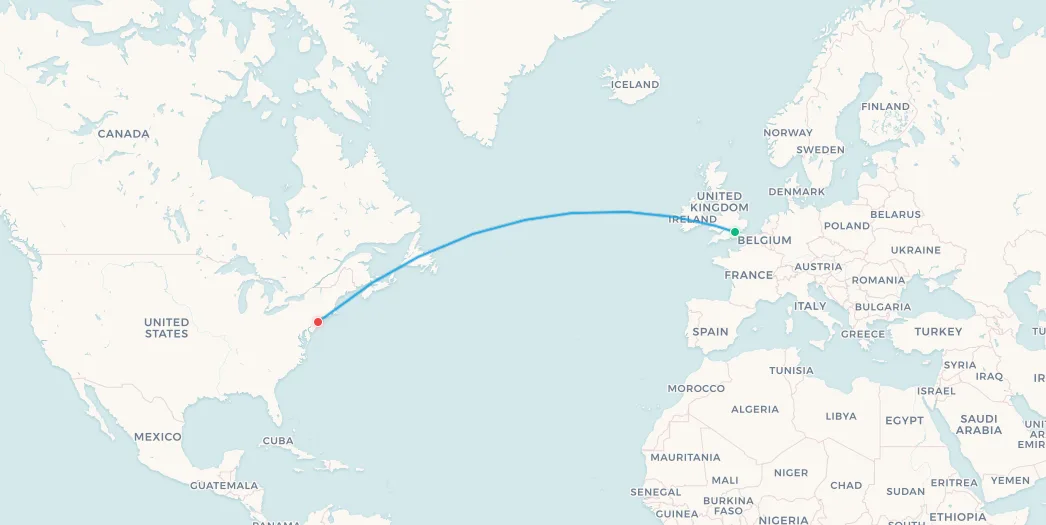
London Heathrow (LHR) to New York JFK (JFK) - British Airways
Airline: British Airways
Flight Numbers: BA001 (LHR→JFK) / BA002 (JFK→LHR)
Distance: 3,459 miles (5,566 km)
Flight Time: ~3 hours 30 minutes westbound / ~3 hours 15 minutes eastbound
Service Period: 22 November 1977 – 24 October 2003
Aircraft: BAC/Aérospatiale Concorde
The London–New York route became the Concorde's most celebrated and commercially successful operation. British Airways operated it under flight numbers BA001 (outbound) and BA002 (return) for 26 years, attracting the business and entertainment elite who could not afford to lose a working day crossing the Atlantic in a conventional jet.
At Mach 2.04, roughly twice the speed of sound, the journey was completed in about 3 hours 30 minutes westbound, and as little as 3 hours 15 minutes eastbound aided by the jet stream. On 7 February 1996, BA002 set a still-unbroken record for the fastest commercial transatlantic crossing: 2 hours, 52 minutes, and 59 seconds from New York JFK to London Heathrow.
One of the unique quirks of this route: departing New York eastbound at around 10:30 AM and arriving in London at approximately 9:30 PM local time, but because of the time zones crossed faster than the clock moves, it was possible to depart New York and arrive in London the same morning. Passengers truly "raced the sun."
➕ Add this route to my map | 🗺️ View this route on the map | 📥 CSV
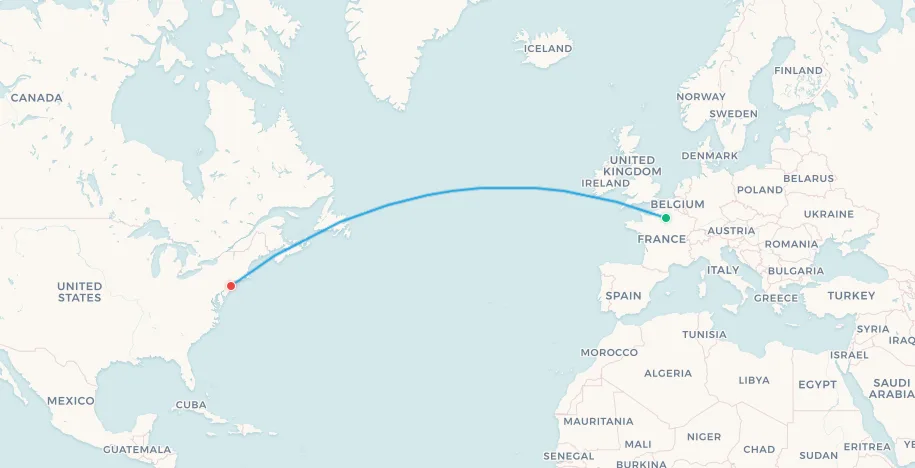
Paris CDG (CDG) to New York JFK (JFK) - Air France
Airline: Air France
Flight Numbers: AF001 (CDG→JFK) / AF002 (JFK→CDG)
Distance: 3,635 miles (5,849 km)
Flight Time: ~3 hours 40 minutes westbound / ~3 hours 25 minutes eastbound
Service Period: 22 November 1977 – 27 June 2003
Aircraft: BAC/Aérospatiale Concorde
Air France's flagship Concorde service was the other pillar of supersonic transatlantic travel. Operating under flight numbers AF001 and AF002, the Paris–New York service ran in parallel with British Airways' London–New York route for 26 years, drawing the same clientele of senior executives, celebrities, and those for whom time was simply worth more than a business-class seat on a subsonic jet.
The slightly longer over-water distance from Paris compared to London meant flight times were typically around 3 hours 40 minutes westbound. Air France retired its Concorde fleet on 27 June 2003, nearly four months before British Airways, citing commercial concerns and the difficulty of maintaining passenger confidence after the 2000 crash.
➕ Add this route to my map | 🗺️ View this route on the map | 📥 CSV
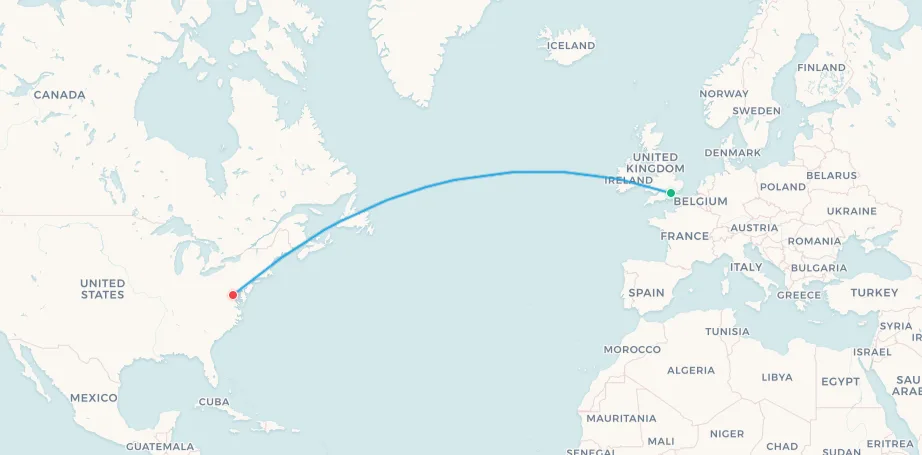
London Heathrow (LHR) to Washington Dulles (IAD) - British Airways
Airline: British Airways
Flight Numbers: BA003 (LHR→IAD) / BA004 (IAD→LHR)
Distance: 3,666 miles (5,900 km)
Flight Time: ~3 hours 45 minutes westbound
Service Period: 1977 – mid-1990s (intermittent)
Aircraft: BAC/Aérospatiale Concorde
British Airways also operated Concorde service to Washington Dulles, providing a supersonic link between London and the American capital. The Washington route served government officials, diplomats, and lobbyists as well as business travellers, a politically important connection between the two countries' power centres.
Less commercially successful than the New York route (London–New York's financial communities drove far greater demand), the Washington service was operated intermittently during the late 1970s through the mid-1990s before being permanently discontinued.
➕ Add this route to my map | 🗺️ View this route on the map | 📥 CSV
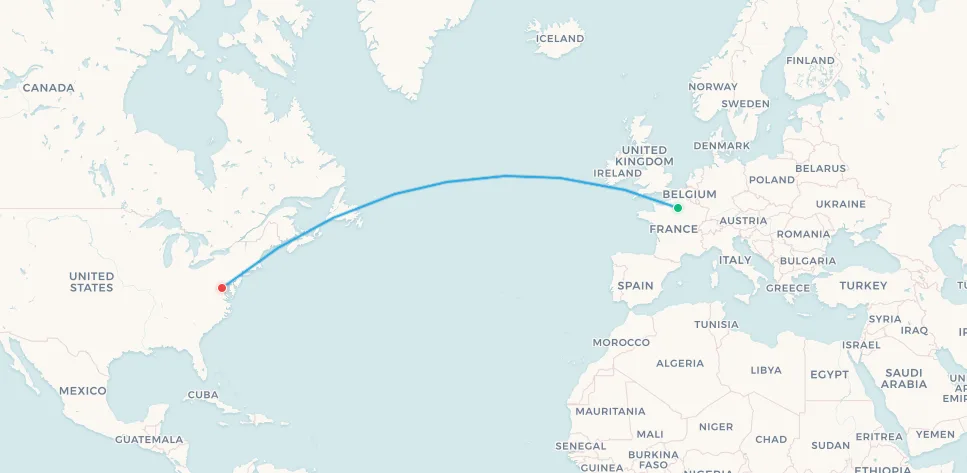
Paris CDG (CDG) to Washington Dulles (IAD) - Air France
Airline: Air France
Flight Numbers: AF083 (CDG→IAD) / AF084 (IAD→CDG)
Distance: 3,840 miles (6,181 km)
Flight Time: ~3 hours 55 minutes westbound
Service Period: 1977 – 1982
Aircraft: BAC/Aérospatiale Concorde
Air France similarly operated Concorde service to Washington Dulles, reflecting the historic ties between France and the United States. The Paris–Washington route carried diplomatic and government passengers alongside the business elite, but it proved less commercially viable than the Paris–New York service and was discontinued in 1982.
➕ Add this route to my map | 🗺️ View this route on the map | 📥 CSV
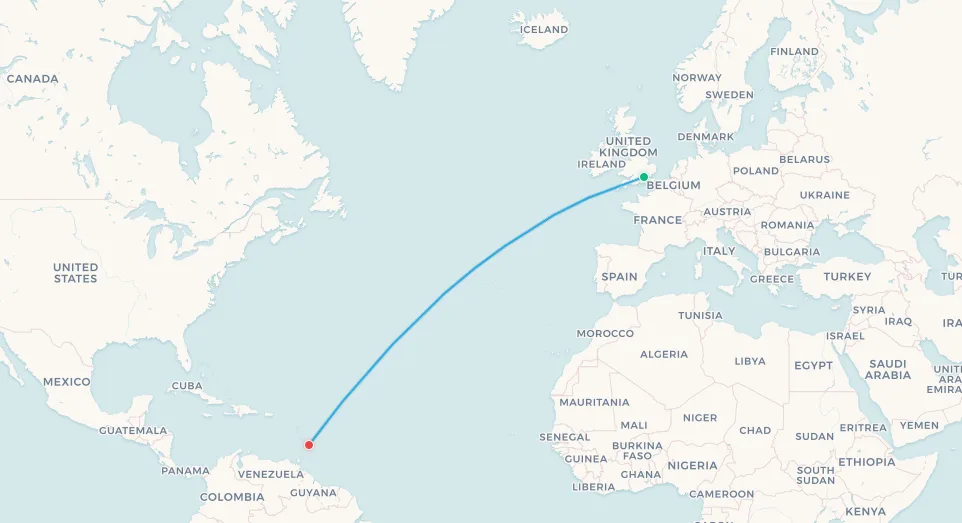
London Heathrow (LHR) to Barbados (BGI) - British Airways (seasonal)
Airline: British Airways
Flight Numbers: BA259 / BA260
Distance: 4,197 miles (6,756 km)
Flight Time: ~4 hours
Service Period: Winter seasons (1987 onwards)
Aircraft: BAC/Aérospatiale Concorde
British Airways operated seasonal Concorde service to Bridgetown's Grantley Adams International Airport in Barbados, a popular winter escape for wealthy British travellers seeking Caribbean sun. Passengers could depart London in the morning and arrive in the Caribbean before noon local time, their four-hour supersonic journey covering more than four thousand miles of open ocean.
The Barbados service was one of the most beloved of the "leisure" Concorde routes, offering a glamorous alternative to the purely business-focused transatlantic schedules. It ran primarily during the British winter season, typically from late December through April.
➕ Add this route to my map | 🗺️ View this route on the map | 📥 CSV
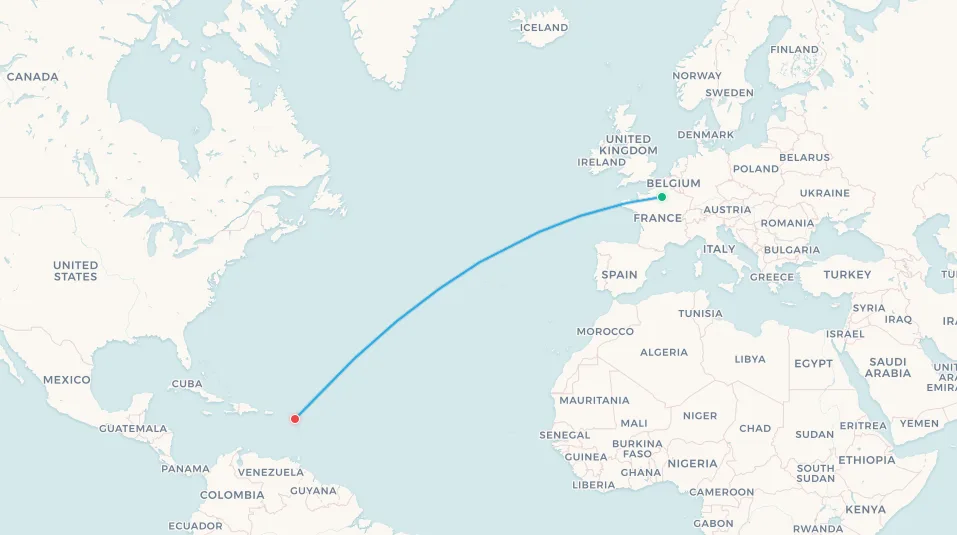
Paris CDG (CDG) to Antigua (ANU) - Air France (seasonal)
Airline: Air France
Flight Numbers: AF055 / AF056
Distance: 4,055 miles (6,526 km)
Flight Time: ~4 hours 10 minutes
Service Period: Winter seasons
Aircraft: BAC/Aérospatiale Concorde
Air France offered seasonal supersonic service to V.C. Bird International Airport in Antigua, catering to the French market's appetite for Caribbean sun. Antigua's position in the Leeward Islands, near French Caribbean territories such as Guadeloupe and Martinique, made it an ideal regional hub for Air France's Caribbean supersonic offering.
➕ Add this route to my map | 🗺️ View this route on the map | 📥 CSV
The early routes (1976–1982)
Before settling into its mature transatlantic network, Concorde operated several pioneering routes that were later discontinued due to commercial pressures or geopolitical constraints. These inaugural services opened the supersonic age on four continents.
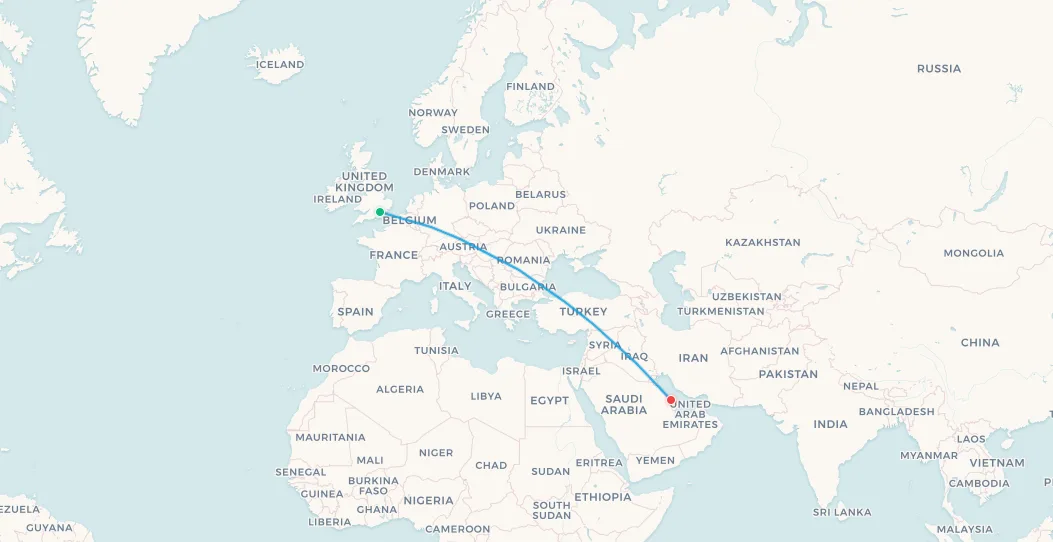
London Heathrow (LHR) to Bahrain (BAH) - British Airways (inaugural)
Airline: British Airways
Flight Numbers: BA011 (LHR→BAH) / BA012 (BAH→LHR)
Distance: 3,355 miles (5,399 km)
Flight Time: ~3 hours 30 minutes
Service Period: 21 January 1976 – 1980
Aircraft: BAC/Aérospatiale Concorde
The London–Bahrain route was the very first commercial Concorde service in history. British Airways launched the route on 21 January 1976, the same day Air France launched its own inaugural Concorde service to Rio de Janeiro. The route connected London with the booming Gulf state at supersonic speed, primarily serving business travellers and diplomats, but Bahrain proved to be too small a market to sustain a regular supersonic service. The route was quietly discontinued in 1980 after four years of operation.
➕ Add this route to my map | 🗺️ View this route on the map | 📥 CSV
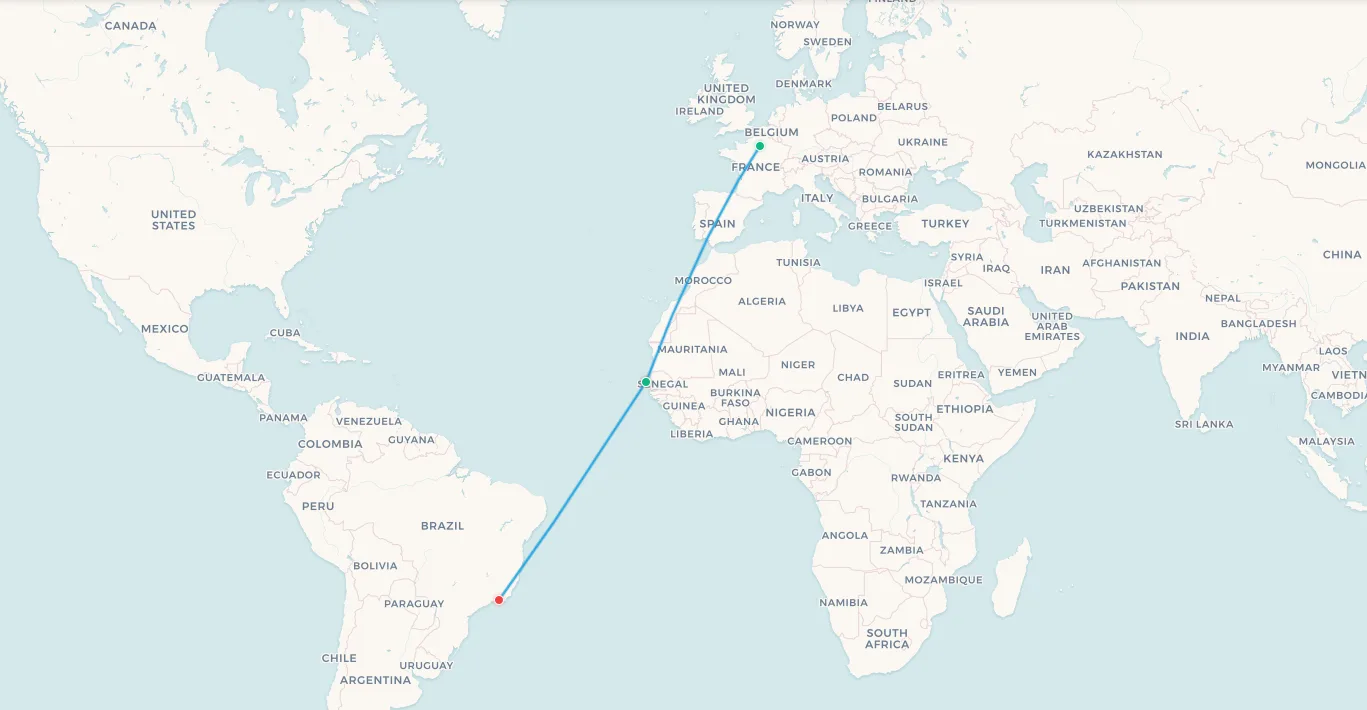
Paris CDG (CDG) to Rio de Janeiro (GIG) via Dakar - Air France (inaugural)
Airline: Air France
Flight Numbers: AF073 (CDG→GIG) / AF074 (GIG→CDG)
Distance: 5,862 miles (9,434 km) with Dakar stop
Flight Time: ~6 hours 50 minutes total (two legs)
Service Period: 21 January 1976 – 1982
Aircraft: BAC/Aérospatiale Concorde
Air France's inaugural Concorde service was a technically impressive two-leg flight from Paris Charles de Gaulle to Dakar, Senegal, and then onward across the South Atlantic to Rio de Janeiro's Galeão International Airport. The stop in Dakar was operationally necessary, the Concorde's range at full supersonic cruise was not sufficient for a direct Paris–Rio crossing. This route, launched simultaneously with British Airways' Bahrain service on 21 January 1976, demonstrated that supersonic flight could span multiple continents. It operated until 1982.
➕ Add these 2 routes to my map | 🗺️ View this route on the map | 📥 CSV
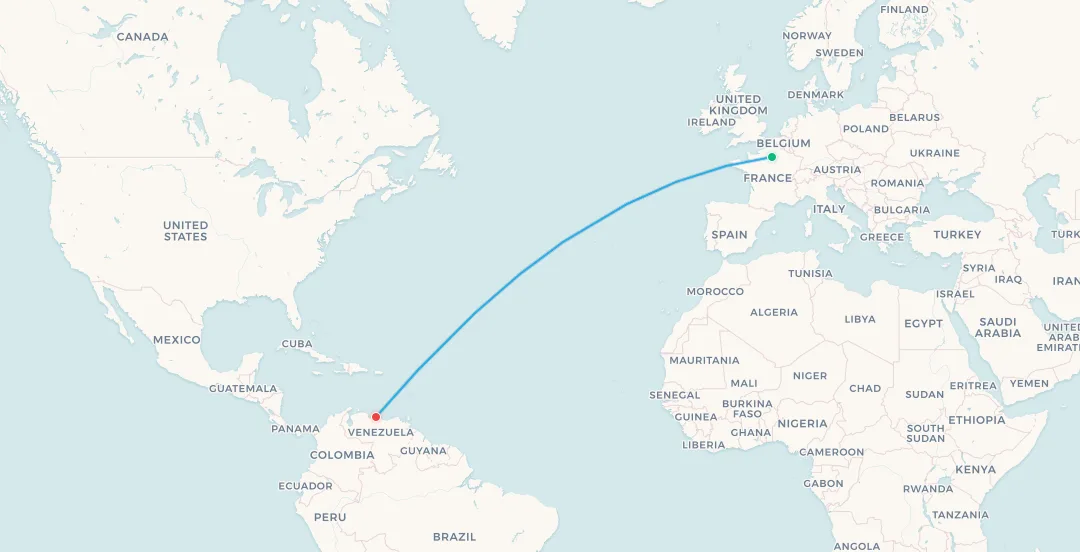
Paris CDG (CDG) to Caracas (CCS) - Air France
Airline: Air France
Flight Numbers: AF079 (CDG→CCS) / AF080 (CCS→CDG)
Distance: 4,746 miles (7,637 km)
Flight Time: ~4 hours
Service Period: 1976 – 1982
Aircraft: BAC/Aérospatiale Concorde
Air France operated supersonic service to Caracas, Venezuela between 1976 and 1982, at the height of Venezuela's oil boom. Caracas was flush with petrodollar wealth in the late 1970s, creating a market for premium travel among the Venezuelan business class and international oil executives. The route demonstrated Air France's ambition to open South America more broadly to supersonic travel. It was discontinued in 1982 alongside the Paris–Rio service as Air France rationalised its Concorde operations to focus exclusively on the lucrative New York route.
➕ Add this route to my map | 🗺️ View this route on the map | 📥 CSV
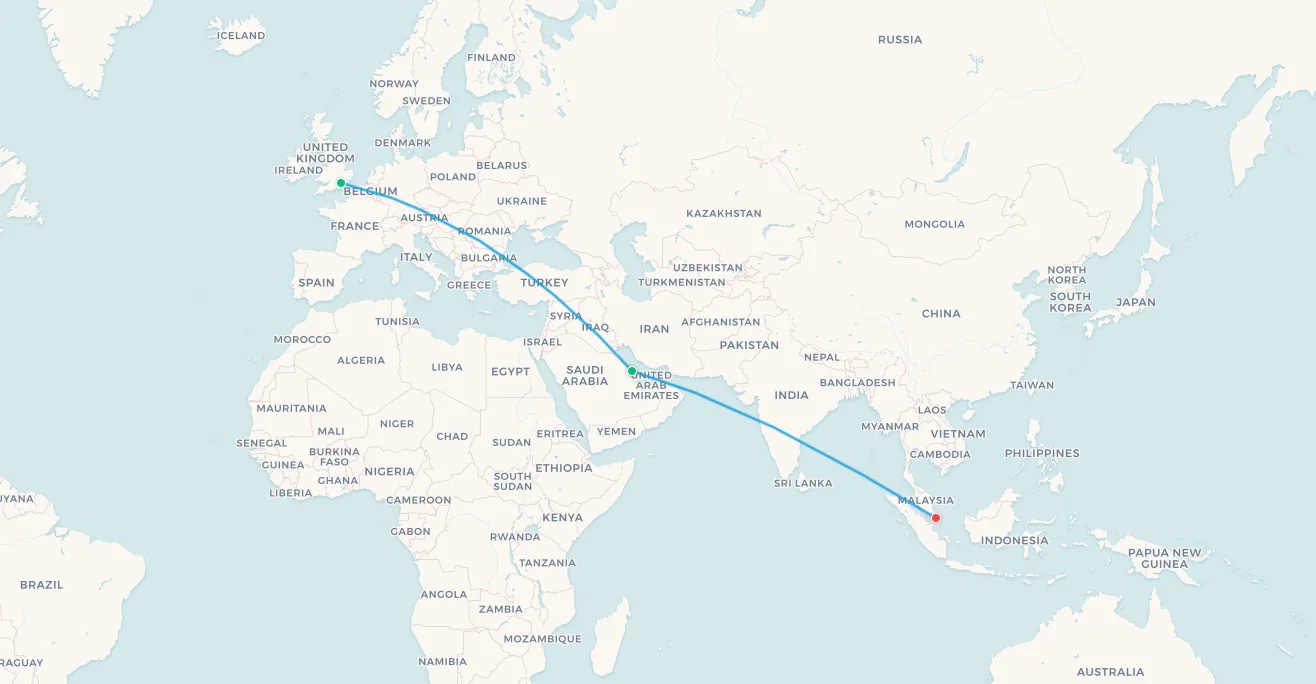
London Heathrow (LHR) to Singapore (SIN) via Bahrain - British Airways & Singapore Airlines
Airlines: British Airways & Singapore Airlines (joint operation)
Flight Numbers: BA300/SQ002 (LHR→BAH→SIN) / BA301/SQ001 (SIN→BAH→LHR)
Distance: 6,764 miles (10,886 km) London–Singapore
Flight Time: ~9 hours total (two supersonic legs via Bahrain)
Service Period: 9 December 1977 – February 1978 (suspended), briefly resumed, then cancelled
Aircraft: BAC/Aérospatiale Concorde (Singapore Airlines colours on the port side, British Airways on the starboard)
The London–Bahrain–Singapore route was one of the most ambitious Concorde services ever attempted, and one of the shortest-lived. British Airways and Singapore Airlines jointly operated a uniquely distinctive aircraft painted in split livery: BA colours on the starboard side, Singapore Airlines colours on the port side. The route used Bahrain as a technical stop due to noise restrictions over India and Malaysia, and the supersonic phase was operated in two legs.
The service was plagued by noise complaints from the Malaysian and Indian governments, who objected to sonic booms over their territory. After just three round trips, the service was suspended in February 1978 and never permanently resumed. It remains one of the great "what could have been" moments in aviation history, Concorde reaching Southeast Asia was theoretically possible, but politically and commercially unfeasible.
➕ Add these 2 routes to my map | 🗺️ View this route on the map | 📥 CSV
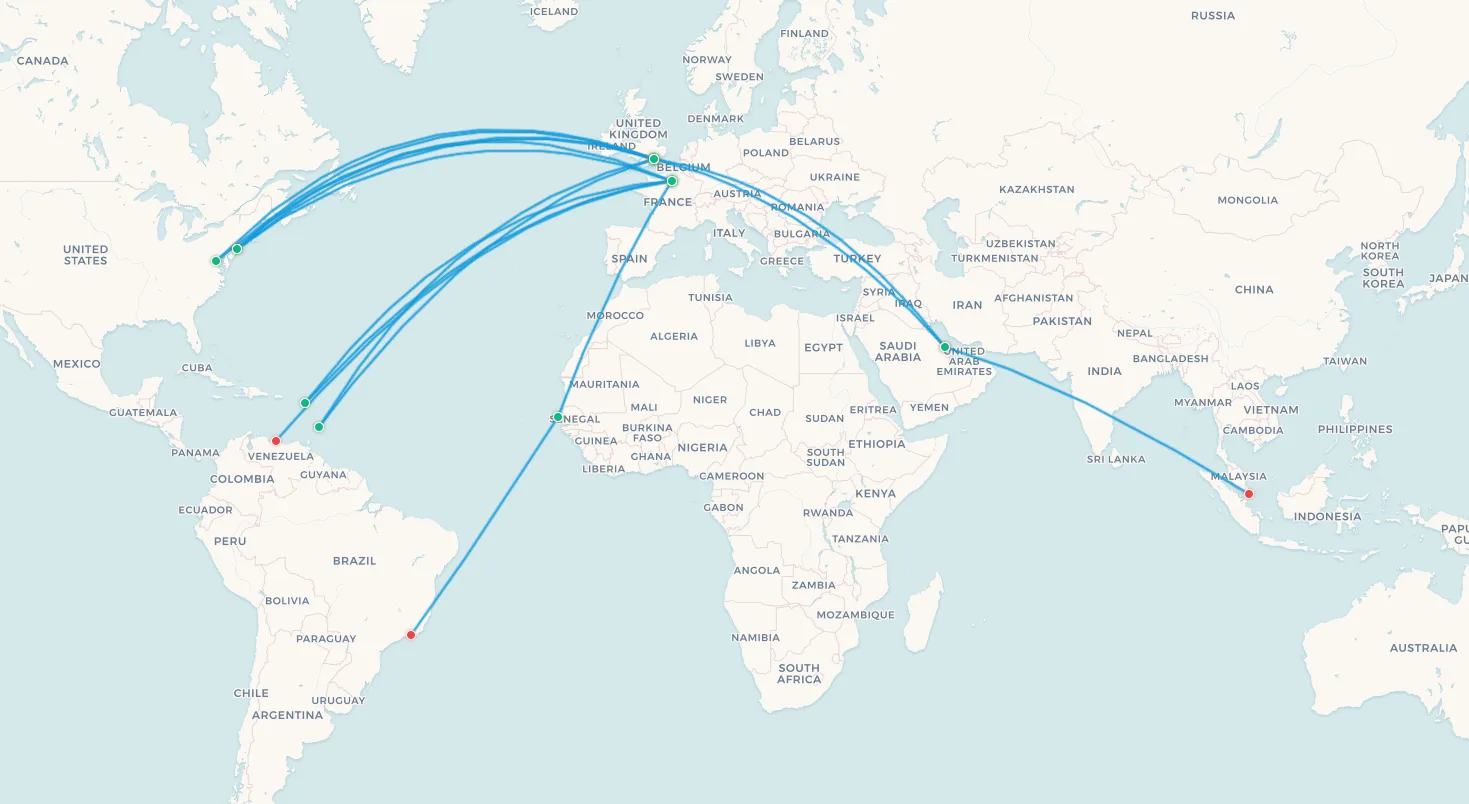
Complete Concorde route network
➕ Add these 16 routes to my map | 🗺️ View all routes on the map | 📥 CSV
Inside the Concorde: the passenger experience
Flying Concorde was unlike anything else in commercial aviation, and that applied as much to the experience inside as to the speeds outside.
- The cabin: Long and narrow, just 8 feet 7 inches (2.62 m) wide internally, significantly narrower than a modern wide-body aircraft. Seating was 2+2, typically 100 passengers. Despite the tight confines, the experience was deeply luxurious: premium champagne, silver-service meals, and an atmosphere more akin to a private jet than a commercial airliner.
- The tiny windows: Windows were approximately the size of a CD case, far smaller than those on a conventional aircraft. The small size was necessary to maintain structural integrity at high altitude and speed. Yet passengers could look out and, at 60,000 feet, see the curvature of the Earth, an experience no other scheduled passenger service routinely offered.
- Temperature and thermal expansion: At Mach 2, aerodynamic heating raised the nose temperature to around 127°C (260°F). The aluminium fuselage expanded by up to 30 cm (12 inches) during flight, a gap large enough, it was said, that a BA engineer kept his hat in it. The cockpit windows were warm to the touch.
- The Mach meter: A prominent Mach number display in the cabin allowed passengers to watch the aircraft accelerate through Mach 1 (the sound barrier) and beyond. The moment of passing Mach 1 was imperceptible, no shudder, no jolt. The display simply ticked past 1.0.
- Ticket prices: In 2003, the final year of service, a British Airways Concorde return ticket between London and New York cost approximately £8,000–£10,000 (equivalent to around £16,000–£20,000 today). This was roughly ten times the cost of a business-class subsonic ticket.
- The food: Concorde menus were curated by top chefs and restaurateurs. The brevity of the crossing, under four hours, meant the meal service was a polished but compressed affair of smoked salmon, fillet of beef, fine wines, and champagne.
Technical specifications
- Maximum speed: Mach 2.04 (1,354 mph / 2,180 km/h)
- Cruise altitude: 56,000–60,000 ft (17,000–18,000 m)
- Range: 4,143 miles (6,667 km)
- Engines: 4 × Rolls-Royce/SNECMA Olympus 593 Mk 610 afterburning turbojets
- Thrust (with afterburner): 38,050 lbf (169.3 kN) per engine
- Length: 202 ft 4 in (61.66 m)
- Wingspan: 83 ft 10 in (25.56 m), ogival delta wing
- Passengers: 92–128 (typically 100)
- Maximum takeoff weight: 408,000 lb (185,065 kg)
- Total built: 20 (2 prototypes, 2 pre-production, 16 production aircraft)
Fascinating facts and records
- Unbroken transatlantic record: The 2 hours, 52 minutes, 59 second crossing set by BA002 on 7 February 1996 (New York to London, aided by a 175 mph tailwind) remains the fastest commercial transatlantic crossing ever recorded. No subsequent passenger aircraft has come close.
- Racing the Sun: Concorde flew so fast eastbound that passengers could depart New York at 10:30 AM Eastern Time and land in London at 9:30 PM local time, but having crossed five time zones faster than the clock moved, their body clocks registered only a three-and-a-half-hour day.
- Seeing the curvature of the Earth: At its cruise altitude of 60,000 feet, Concorde passengers could see the Earth's curve against the dark blue of near-space, something no other commercial aircraft ever routinely offered its passengers.
- The drooping nose: Concorde's distinctive forward-tilting "droop nose" could be lowered by 5° for taxi and takeoff, and 12.5° for landing, giving pilots improved forward visibility over the aircraft's steep nose-high landing attitude. It became one of aviation's most recognised silhouettes.
- Phil Collins and Live Aid: On 13 July 1985, Phil Collins flew Concorde from London to New York after performing at the UK Live Aid concert at Wembley Stadium, in time to perform again at the US Live Aid concert in Philadelphia, making him the only artist to appear at both events on the same day.
- Famous passengers: Queen Elizabeth II, Princess Diana, Paul McCartney, Mick Jagger, David Bowie, Elton John, Luciano Pavarotti, Michael Jackson, and numerous heads of state all flew Concorde. Its passenger lists read as a who's who of the late 20th century.
- Fuel consumption: Concorde burned approximately 25,628 litres (5,638 Imperial gallons) of fuel per hour, roughly four times as much as a Boeing 747, while carrying just one-quarter of the passengers.
- Total passengers carried: Over its 27 years of commercial service, Concorde carried approximately 2.5 million passengers, according to British Airways.
- The sonic boom: Concorde's sonic boom, a distinctive double bang caused by the shockwaves from nose and tail, restricted supersonic flight to over-ocean routes. It was never permitted to exceed the speed of sound over populated land in any country.
Air France Flight 4590 crash (25 July 2000)
On 25 July 2000, Air France Concorde Flight 4590 crashed shortly after takeoff from Paris Charles de Gaulle Airport, killing all 109 people on board, 100 passengers and 9 crew, as well as 4 people on the ground at the hotel where the aircraft came down in Gonesse, France. It was the only fatal accident involving a Concorde in commercial service.
The French Bureau d'Enquêtes et d'Analyses (BEA) investigation found that a titanium strip, a wear strip from a thrust reverser, had fallen from a Continental Airlines DC-10 that had taken off from the same runway shortly before. The strip punctured one of Concorde's tyres. A large piece of rubber struck the underside of the wing, causing a fuel tank to rupture. The escaping fuel ignited, and the crew found they could neither extinguish the fire nor retract the landing gear. Unable to return to the airport, the aircraft crashed into the Hôtelissimo Les Relais Bleus hotel in Gonesse, 10 km from the airport.
The entire Concorde fleet was grounded immediately. Following extensive modifications, reinforced fuel tanks, Kevlar-lined fuel tank bays, improved tyre design, and improved electrical wiring, Concorde returned to commercial service on 7 November 2001, some 16 months after the crash.
Why did Concorde retire?
Concorde's retirement in 2003 was the result of several converging factors:
- Economics: Concorde was never commercially self-sustaining in any conventional sense. It carried 100 passengers on a service that required more fuel per seat-mile than any other aircraft in history. High ticket prices, necessary to offset costs, limited the market to the ultra-wealthy. By the early 2000s, subsonic business class had improved dramatically with lie-flat seats and onboard suites, narrowing the comfort gap with Concorde's premium offering.
- The 2000 crash: Although Concorde returned to service after modifications, the Air France Flight 4590 crash had damaged passenger confidence. Revenue load factors never fully recovered to pre-crash levels.
- Post-9/11 collapse in transatlantic demand: The September 11 attacks in 2001 devastated premium transatlantic travel, Concorde's core market. High-net-worth travellers cancelled trips and many shifted permanently to private jets or premium subsonic cabins.
- Ageing airframes: The 16 production Concordes were aging aircraft in a class of one. Spare parts were scarce, maintenance was extraordinarily expensive, and there was no successor programme to share development costs.
- Airbus withdrawal of support: In 2003, Airbus, successor to Aérospatiale/BAC through various mergers, announced it would no longer provide technical support or airworthiness certification for the aircraft. Without manufacturer support, continued safe operation became legally untenable.
British Airways flew its final scheduled Concorde service on 24 October 2003, a triple-header with G-BOAF, G-BOAG, and G-BOAE landing at Heathrow within minutes of each other to an emotional crowd of thousands. Air France had retired its fleet on 27 June 2003. The age of commercial supersonic flight was over.
Where are the Concordes today?
Of the 20 Concordes ever built, those that survived to retirement are preserved in museums across the UK, France, and the United States:
- G-BOAA: National Museum of Flight, East Fortune, Scotland
- G-BOAB: Heathrow Airport, stored, the only Concorde still at its operational base
- G-BOAC: Manchester Airport Runway Visitor Park, England
- G-BOAD: Intrepid Sea, Air & Space Museum, New York City, USA
- G-BOAE: Barbados Museum & Historical Society, Bridgetown, Barbados, fittingly, at one of Concorde's leisure destinations
- G-BOAF: Aerospace Bristol, Filton, Bristol, the last Concorde to fly, in the city where the British prototype was built
- G-BOAG: Museum of Flight, Seattle, Washington, USA
- F-BVFA: Aeroscopia Museum, Toulouse, France
- F-BVFC: Smithsonian National Air and Space Museum (Steven F. Udvar-Hazy Center), Chantilly, Virginia, USA
- F-BTSD: Le Bourget, Musée de l'Air et de l'Espace, Paris, France
Legacy and the future of supersonic travel
Concorde's retirement left a void that has not been filled for more than two decades. The aircraft remains the only commercial supersonic passenger airliner ever to enter regular scheduled service. Several companies are now developing next-generation supersonic aircraft directly inspired by Concorde's legacy:
- Boom Supersonic (Overture): The Denver-based company is developing the Overture, targeting Mach 1.7 and 64–80 seats. United Airlines has placed an order for 15 aircraft with options for 35 more, and American Airlines has placed an order for 20 aircraft. First commercial flights are targeted for the late 2020s.
- NASA X-59 QueSST: NASA's experimental low-boom supersonic demonstrator is designed to reduce the sonic boom to a quiet "thump" barely perceptible on the ground, potentially opening land-based supersonic routes for the first time. Test flights began in 2024.
- Exosonic and Hermeus: Several smaller companies are pursuing supersonic business jets and point-to-point supersonic transports with government backing.
The challenges remain substantial: fuel efficiency, sonic boom regulation, certification frameworks, and the economics of supersonic travel at scale. But Concorde proved it was possible, and the dream of crossing the Atlantic in under four hours has never entirely faded.
Add historical flights to your map
Concorde may be retired, but its routes live on as some of the most iconic in aviation history. You can visualise any Concorde route in the My Flight Routes app by entering the origin and destination, perfect for commemorating a flight you were lucky enough to take, or simply exploring aviation history.