What Makes a Flight Transpolar
On a flat map, a flight from Dubai to Seattle ought to head west across Europe and the Atlantic. On a globe it goes almost straight north. The shortest path between the two cities climbs over Iran, Central Asia and Russia, crosses the Arctic Ocean, passes about 170 km from the North Pole, and comes down through Canada. That is a transpolar route: a flight whose shortest path runs over the top of the world, because that is where the shortest path happens to be.
This guide lists the routes that really do it, measured rather than guessed. For each one we computed the great-circle peak, the northernmost point of the shortest path between the two airports, from the same airport database the My Flight Routes map uses. That number never changes. Who flies the route does, so airlines are given as a snapshot checked in September 2026. Actual tracks are planned every day around the winds and can pass a few hundred kilometres either side of the line.
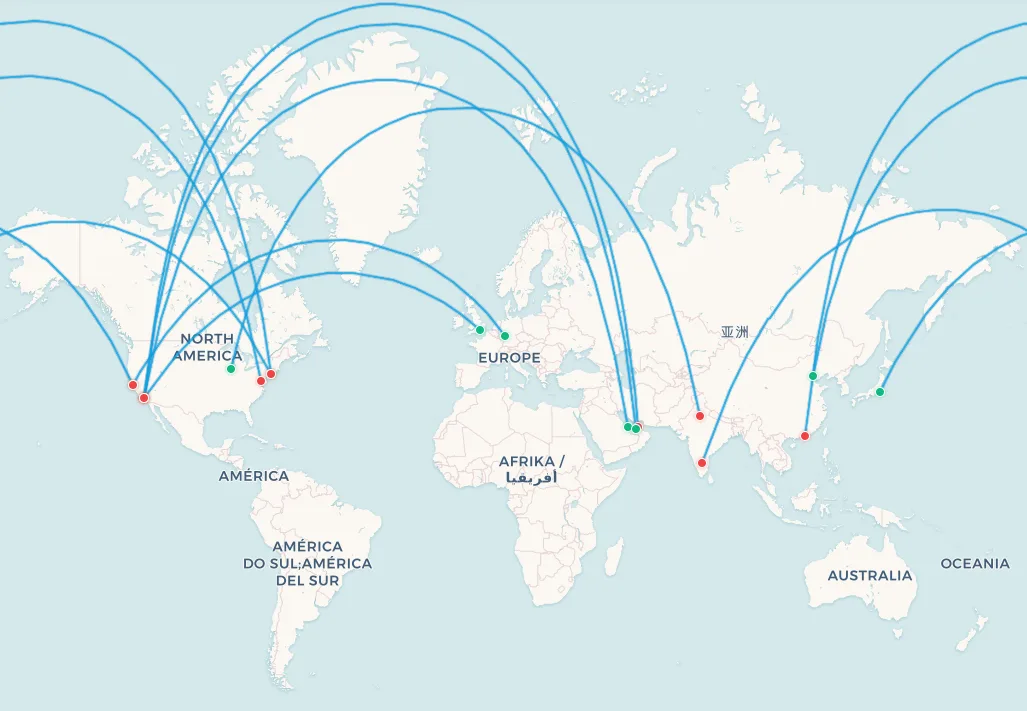
➕ Add these 13 routes to my map | 🗺️ Preview on the map | 📥 CSV
| Route | Distance | Great-circle peak | Flown by (Sept 2026) |
|---|---|---|---|
| Dubai (DXB) to Seattle (SEA) | 11,928 km (7,412 mi) | 88.5°N | Emirates |
| Dubai (DXB) to San Francisco (SFO) | 13,020 km (8,090 mi) | 88.2°N | Emirates |
| Newark (EWR) to Singapore (SIN) | 15,336 km (9,529 mi) | 87.9°N | Singapore Airlines |
| Doha (DOH) to Seattle (SEA) | 11,906 km (7,398 mi) | 86.1°N | Qatar Airways |
| New York (JFK) to Hong Kong (HKG) | 12,970 km (8,059 mi) | 84.0°N | Cathay Pacific |
| New York (JFK) to Beijing (PEK) | 10,978 km (6,821 mi) | 83.9°N | Air China |
| Doha (DOH) to Los Angeles (LAX) | 13,347 km (8,293 mi) | 81.4°N | Qatar Airways |
Two things decide whether a route goes over the top. Geometry, which is permanent. And politics, which is not: since 2022, which airline you fly can matter as much as where you are going. Both are below.
Closest to the Pole: the Gulf to the US West Coast
➕ Add these 4 routes to my map | 🗺️ Preview on the map | 📥 CSV
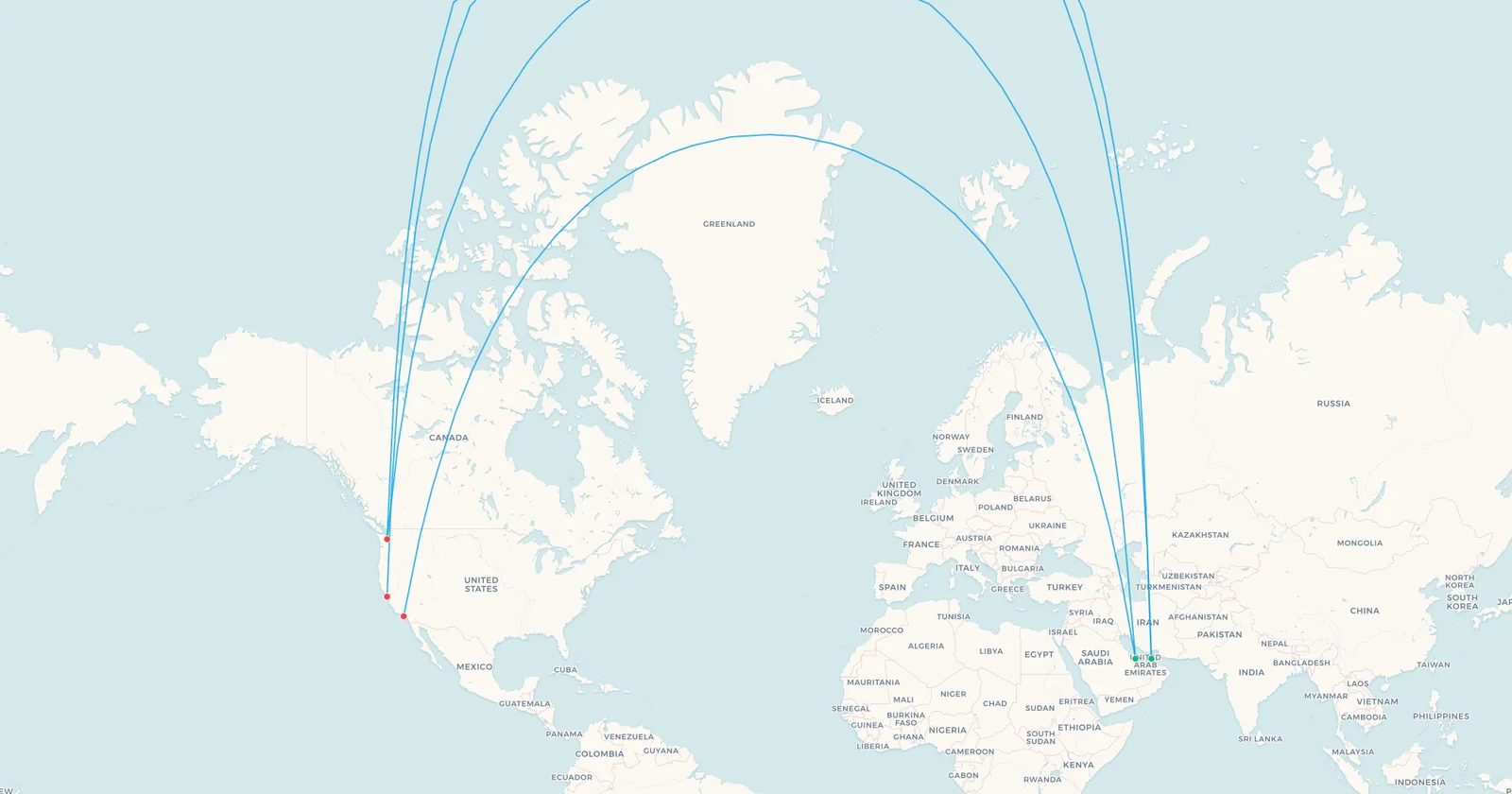
On a flat map, a route over the Pole runs off the top edge and comes back down: that near-vertical climb is what 'over the top' looks like in the Mercator projection.
Search flights Dubai → SeattleSearch flights DXB → SEAThe routes that come closest to the North Pole are not the famous ones between America and Asia. They run between the Persian Gulf and the Pacific Northwest. Dubai to Seattle peaks at 88.5°N and Dubai to San Francisco at 88.2°N, both within about 200 km of the Pole. Doha to Seattle reaches 86.1°N and Doha to Los Angeles 81.4°N.
Emirates flies to both Seattle and San Francisco daily, Seattle with a 777-200LR through 2026. Qatar Airways flies Doha to Seattle daily, San Francisco twice a week and Los Angeles. Both airlines can still cross Russian airspace, which on these routes covers the long northbound stretch from the Caspian to the Arctic Ocean. That is why these great circles are flyable at all.
US East Coast to Asia Across the Arctic
➕ Add these 3 routes to my map | 🗺️ Preview on the map | 📥 CSV
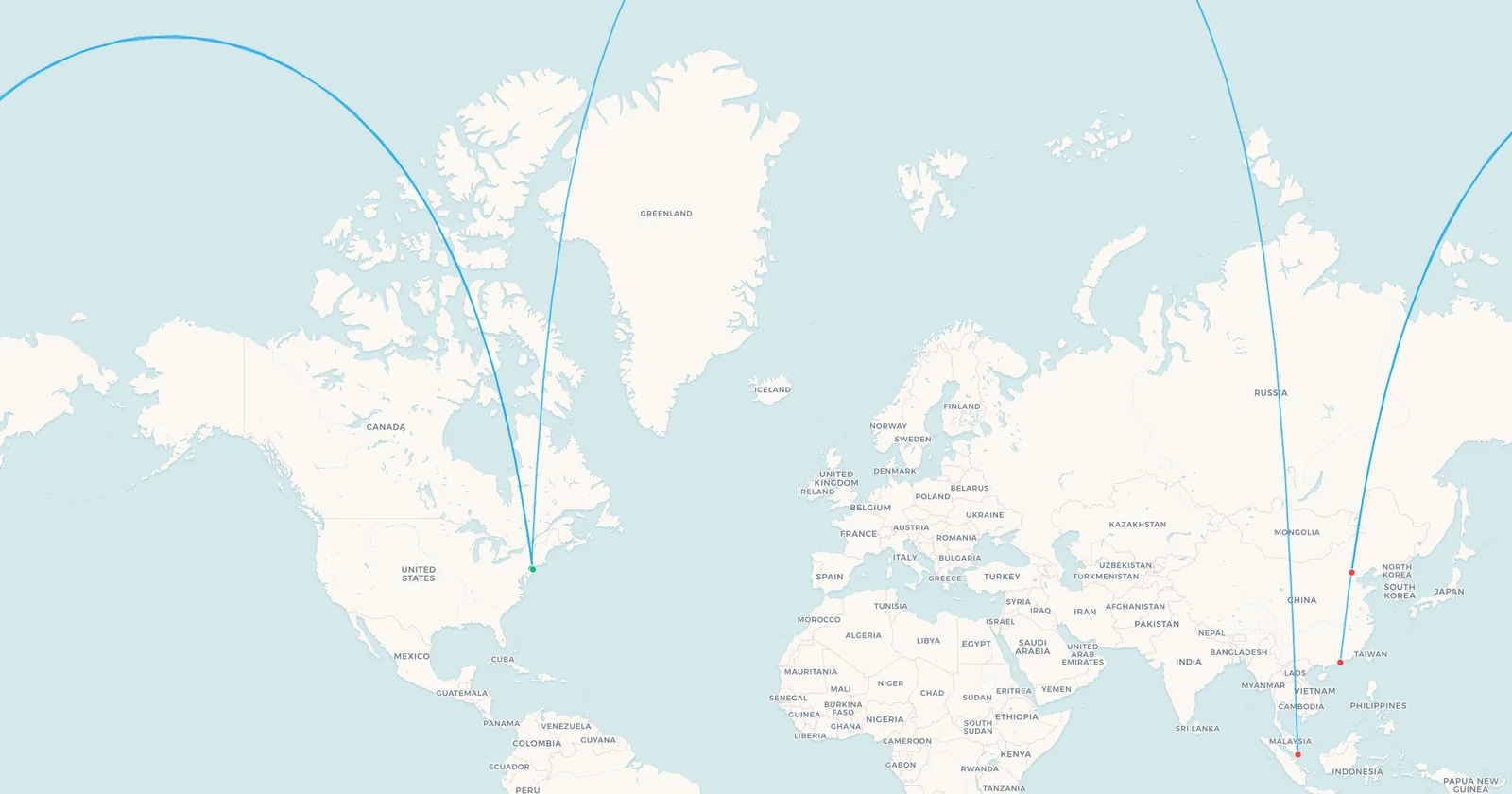
Search flights New York → Hong KongSearch flights JFK → HKGFrom New York, the shortest way to East Asia is north over Canada and the Arctic Ocean, then south across Siberia. New York to Hong Kong peaks at 84.0°N and New York to Beijing at 83.9°N. Cathay Pacific stopped using Russian airspace in March 2022, found the detour too costly on its New York flights, and went back to the polar route in November 2022, saving close to two hours. Air China flies the Beijing route.
The extreme case is Newark to Singapore, 15,336 km (9,529 mi), one of the longest flights in the world. Its great circle peaks at 87.9°N. Singapore Airlines' SQ21 can take a polar routing that reaches about 87°N when the winds favour it, while the return, SQ22, usually crosses the Pacific instead. Same city pair, two different routes, which is how ultra-long-haul flights work: the shortest path is the starting point, the winds decide the rest. Our list of the world's longest flights has the full ranking.
The Russian Airspace Ban Redrew the Arctic
In February 2022 the European Union, the UK, the United States and Canada closed their airspace to Russian airlines, and Russia answered by closing its own to airlines from those countries and dozens of others. Most transpolar great circles between North America and Asia cross Siberia, so the ban split the world's airlines into two groups:
- Airlines that can still overfly Russia, including those from the Gulf, China, Hong Kong, India and Turkey, can fly the shortest path.
- US, Canadian and European airlines cannot, and route around, often over the Pacific or through Central Asia, sometimes hours longer on the same city pair.
Access to one airspace is not the whole story. Air India can still cross Russia, but Pakistan closed its airspace to Indian airlines in April 2025, and from March 2026 Air India consolidated its San Francisco flights on Delhi, some of them with a refuelling stop. The Bangalore to San Francisco nonstop, once billed as a polar flight, is gone. We looked at how closed airspace bends routes in general in why flights don't fly in a straight line.
Europe to Japan: the Cold War Route Returns
➕ Add this route to my map | 🗺️ Preview on the map | 📥 CSV
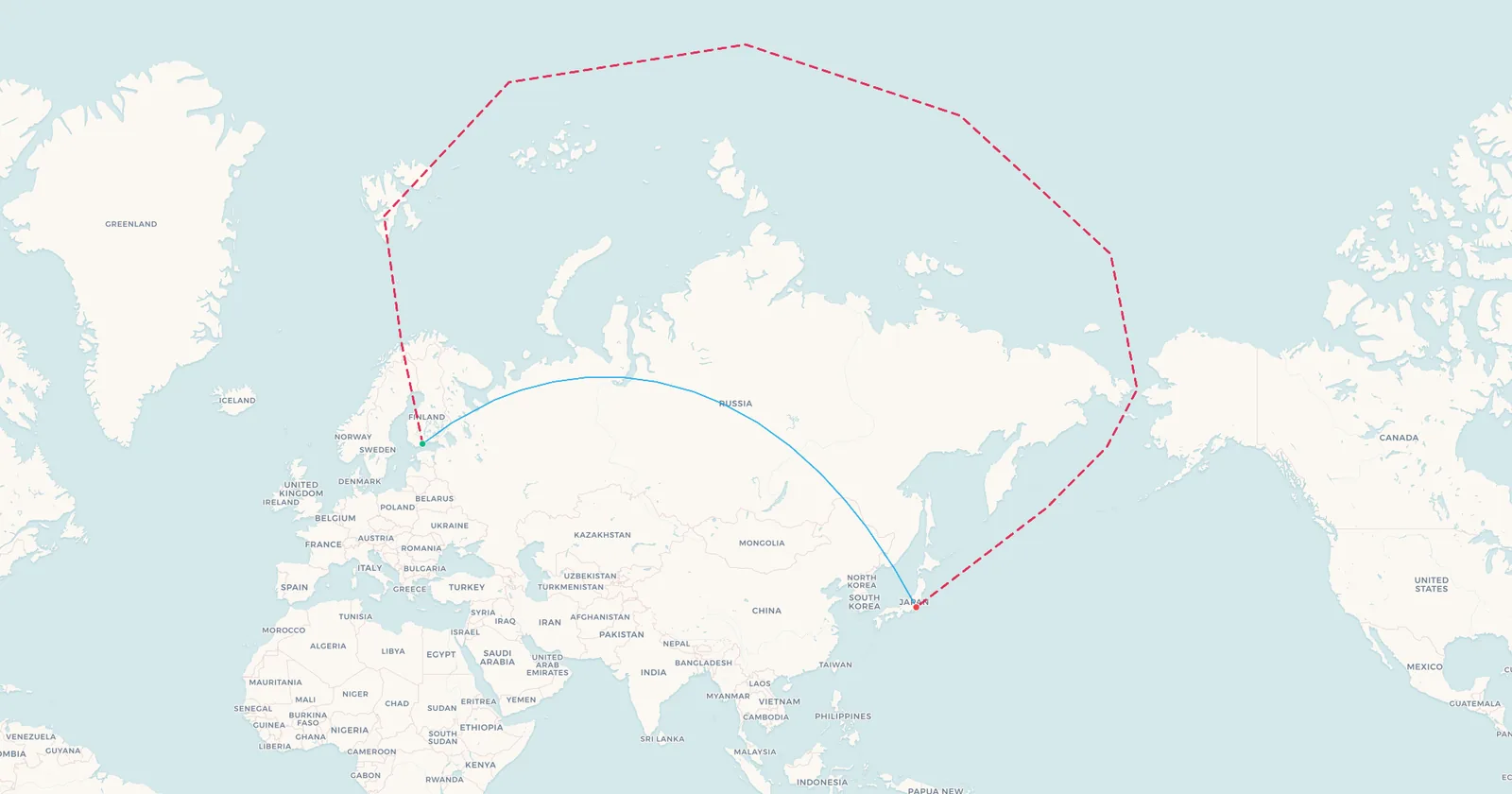
Solid line: the great circle across Russia, closed to Finnair since 2022. Dashed line: the polar detour flown when winds allow, drawn approximately.
Search flights Helsinki → TokyoSearch flights HEL → HNDFinnair built its business on the shortest link between Europe and Asia: Helsinki to Tokyo, 7,824 km (4,862 mi) straight across Russia. When that airspace closed, the airline went north instead. On the polar route, the A350 heads over Svalbard, crosses the Arctic Ocean towards Alaska and comes down over the Bering Sea, skirting Russian airspace, into Japan. It adds hours, cost Finnair a whole aircraft rotation, and needed longer ETOPS approval for its A350s. Depending on the winds, Finnair now flies either this polar route or a southern one through Central Asia.
Japan's airlines split the same way in 2022. JAL routed Haneda to London across Alaska and Canada, several hours longer than before, while ANA chose Central Asia, citing the lack of diversion airports in the high Arctic. Either way, Europe to Japan is once again a route that goes around Russia, which is exactly how it began.
How It Started: SAS, 1954 and 1957
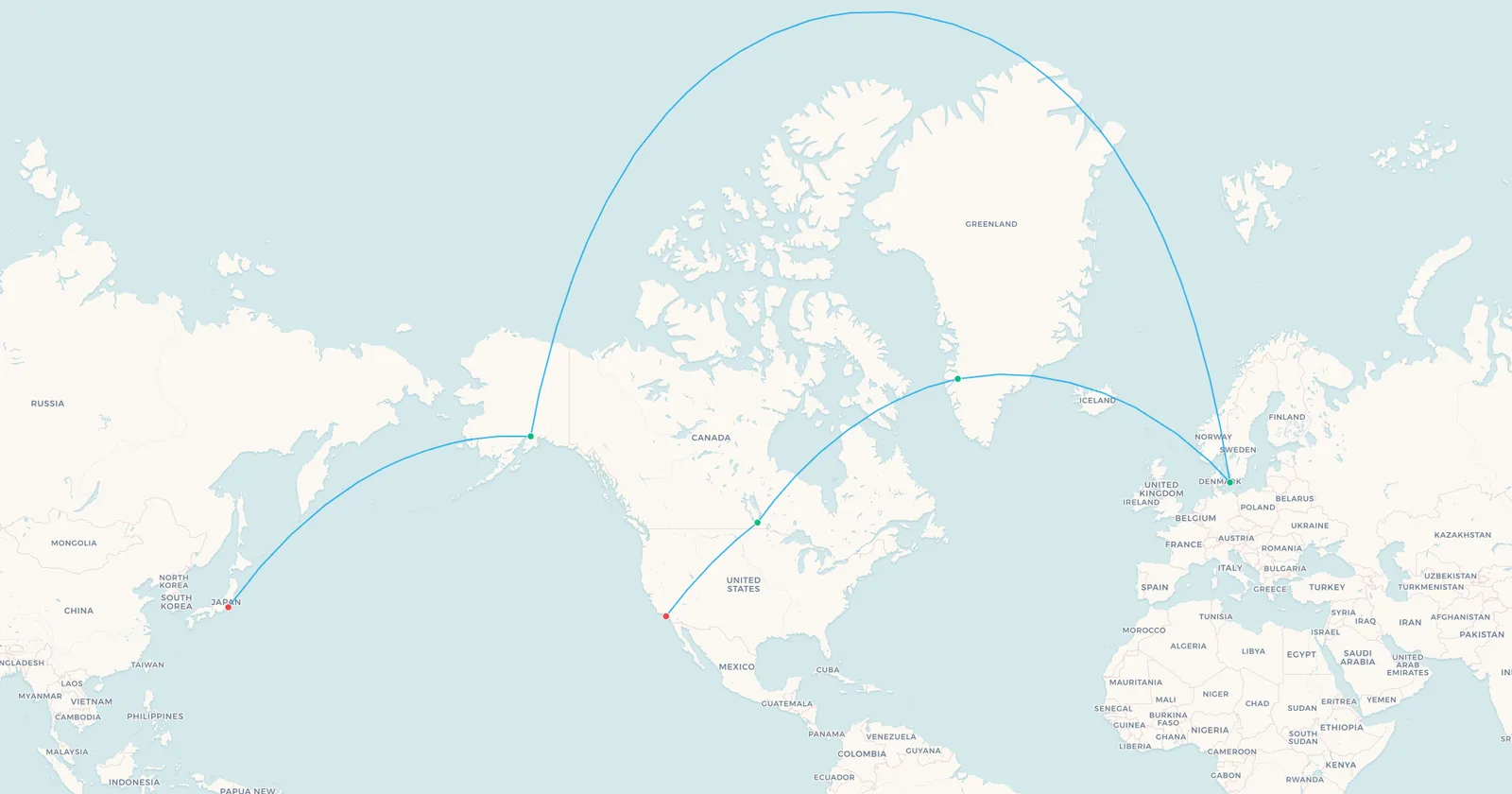
➕ Add these 5 routes to my map | 🗺️ Preview on the map | 📥 CSV
The CSV carries the original dates, so these import as the historic flights.
The first commercial polar service was Scandinavian Airlines' Copenhagen to Los Angeles, inaugurated on 15 November 1954 with Douglas DC-6Bs stopping at Søndre Strømfjord in Greenland (now Kangerlussuaq) and Winnipeg. Scandinavia is well placed for the Arctic, and SAS saw the shortcut before anyone else.
On 24 February 1957 it went further, with the first regular service across the North Pole: Copenhagen to Tokyo via Anchorage in DC-7Cs, about 32 hours against 50 on the old southern route. The Copenhagen to Anchorage leg alone peaks at 84.7°N. Through the Cold War, with Soviet airspace closed to Western airlines, Anchorage became a refuelling stop for flights between Europe and Japan; by the end of 1961 JAL was flying Tokyo to Copenhagen, London and Paris that way. Once Russian airspace opened and aircraft could fly the distance nonstop, the stop disappeared. The 2022 ban has brought the polar route back, this time without the fuel stop.
Routes That Feel Polar but Are Not
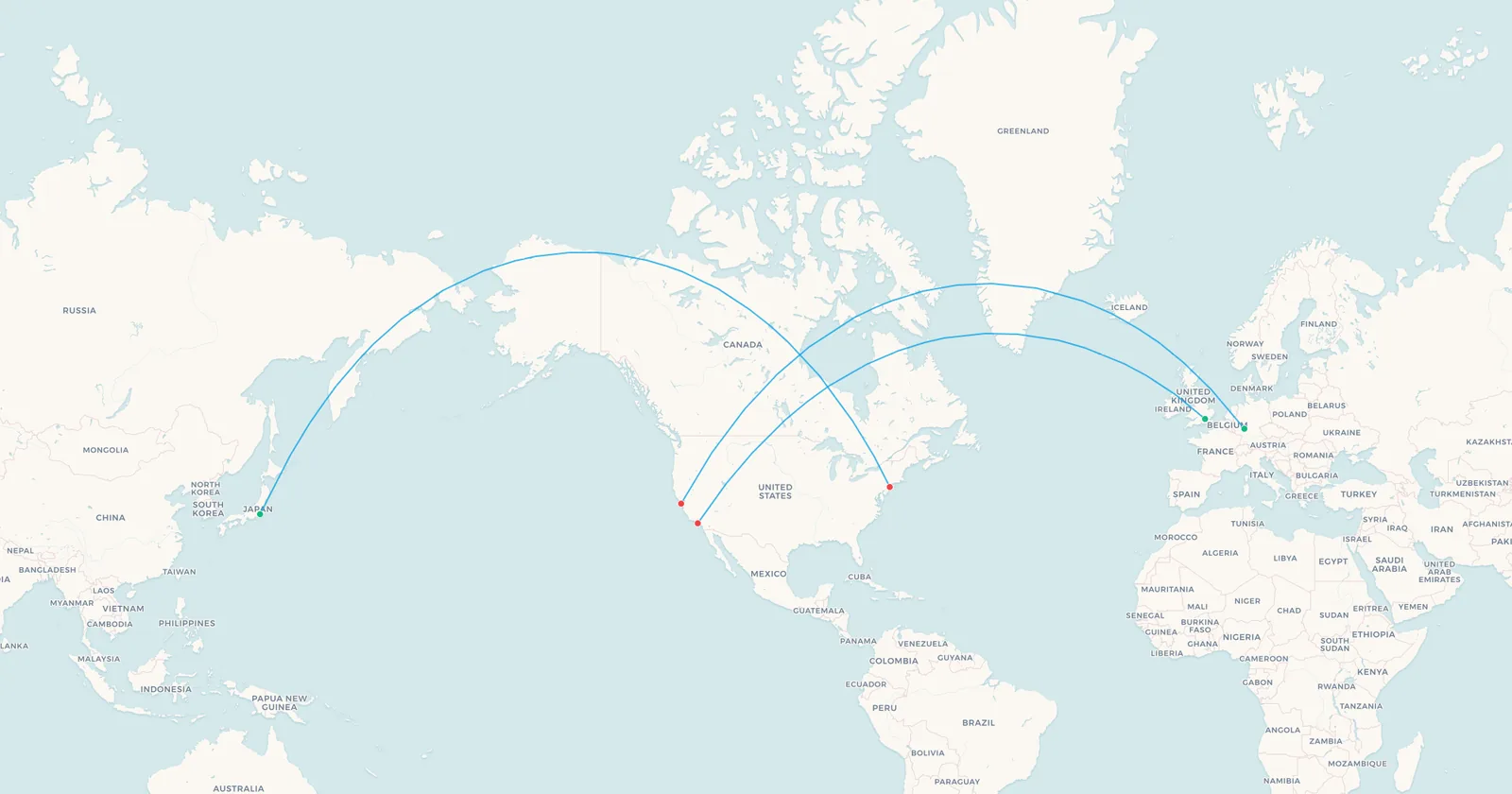
➕ Add these 3 routes to my map | 🗺️ Preview on the map | 📥 CSV
Search flights London → Los AngelesSearch flights LHR → LAXPlenty of routes are described as polar because they pass over Greenland or Alaska, and the view certainly looks the part. The geometry says otherwise:
- London to Los Angeles peaks at 62.3°N, below the Arctic Circle (66.6°N). It crosses southern Greenland and Hudson Bay, and it is not a polar flight at all.
- Frankfurt to San Francisco peaks at 67.2°N, just inside the Arctic Circle over the Greenland ice sheet.
- Tokyo Haneda to New York peaks at 69.9°N over Alaska and northern Canada.
These are high-latitude routes, and often better for the view than the true polar ones: they spend hours over ice and mountains in daylight rather than over featureless Arctic sea ice. They are simply not over the top. The same goes for the old San Francisco to Bangalore flight, which never went further north than 70.9°N.
The Southern Version: Australia to South America
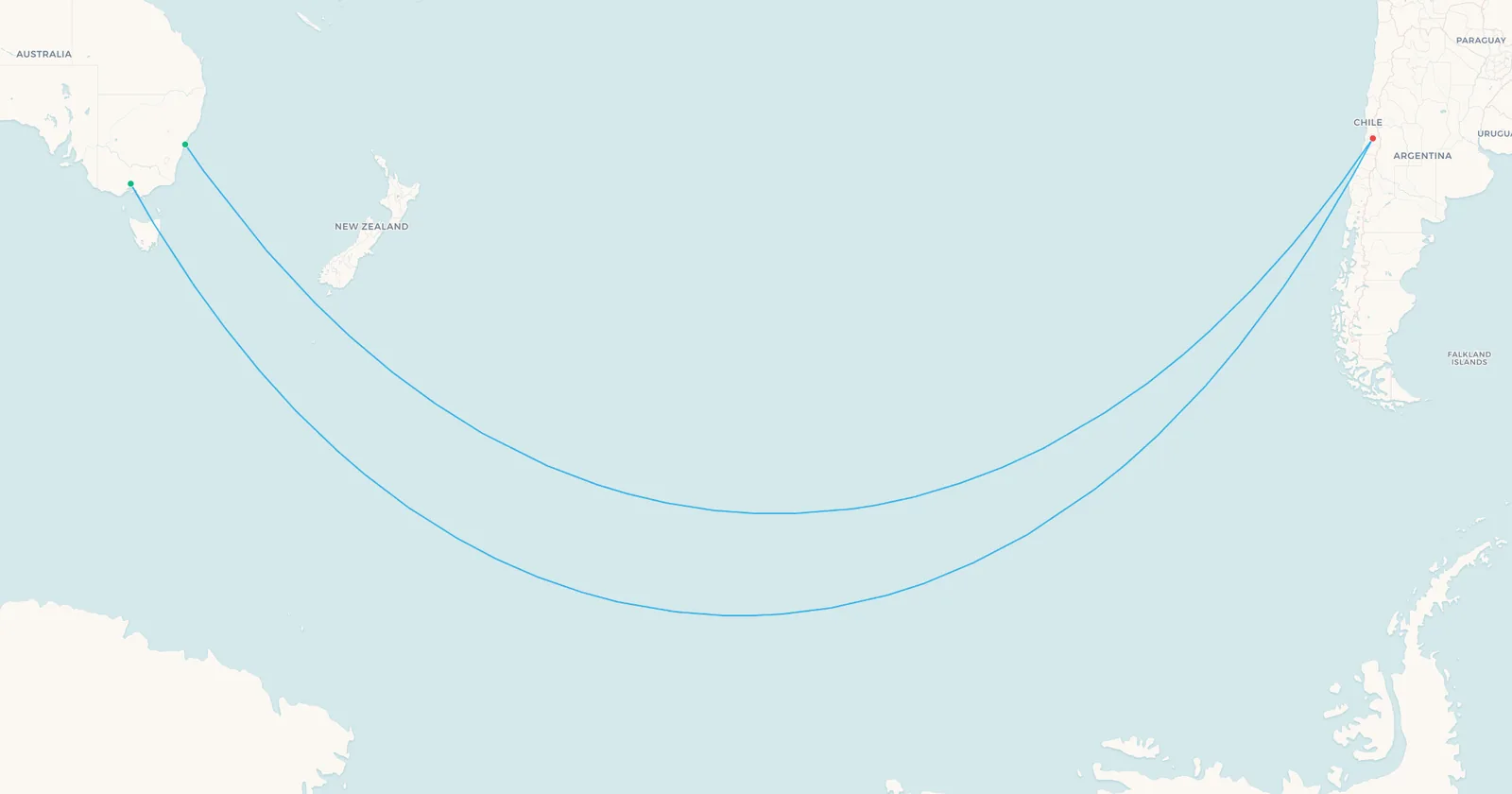
➕ Add these 2 routes to my map | 🗺️ Preview on the map | 📥 CSV
Search flights Sydney → SantiagoSearch flights SYD → SCLThere is no scheduled flight across Antarctica, but two routes come close. Melbourne to Santiago, launched by LATAM in 2017 and flown again since 2023, has a great circle that dips to 66.9°S, just inside the Antarctic Circle, making it the southernmost scheduled passenger route in the world. Qantas flies Sydney to Santiago four times a week; its great circle reaches 61.7°S, and on days with strong headwinds the flight has been planned further south still, along the Antarctic coast.
These flights face the same problem as the Arctic ones with fewer answers: almost nowhere to divert to between Oceania and South America. More on the routes themselves in our guide to South America to Australia flights, and on getting to the ice itself in flights to Antarctica.
What It Takes to Fly Over the Pole
- Diversion airports. Twin-engine aircraft must stay within a certified flying time of an airport where they could land (ETOPS), and the high Arctic has very few. Longer approvals are what made modern polar routes possible.
- Cold fuel. Jet A-1 freezes at around -47°C, and hours at cruise over the Arctic can chill it towards that limit. Crews watch fuel temperature and descend or speed up if it gets close.
- Communications. Geostationary satellites sit low on the horizon or below it near the Pole, so polar flights rely on HF radio and satellite systems with polar coverage.
- Navigation. Magnetic compasses become useless close to the magnetic pole; aircraft navigate on inertial systems and GPS.
- Radiation and space weather. Cosmic radiation is higher at polar latitudes, and during strong solar storms airlines move flights off polar routes altogether.
What You Can See
In winter, night flights across the Arctic are among the best places in the world to see the northern lights, from above the clouds. In summer the same routes stay in daylight around the clock under the midnight sun. On clear days the sights are the Greenland ice sheet, the sea ice of the Arctic Ocean with its long cracks of open water, and the mountains of Alaska and the Canadian Arctic. Most of the time, over the Pole itself, it is simply white.
To trace any route over the top of the world yourself, what countries will I fly over draws it on a globe and lists every country under the great circle, with how long you spend above each one.
Frequently Asked Questions
What is a transpolar flight?
A flight whose shortest path crosses the polar region. In practice the term covers routes whose great circle crosses the Arctic Circle, and the true "over the top" routes pass north of 80°N. The shortest path between the Gulf and the US West Coast, for example, runs within about 200 km of the North Pole.
Which flight goes closest to the North Pole?
Among scheduled routes, the Gulf to the US Pacific Northwest. Dubai to Seattle has a great circle that peaks at 88.5°N, about 170 km from the Pole, and Dubai to San Francisco peaks at 88.2°N. Actual tracks vary with the winds, so a given flight may pass a few hundred kilometres to either side.
Why don't US airlines fly over the North Pole to Asia?
Most polar routes between North America and Asia cross Siberia, and Russia has closed its airspace to US, Canadian and European airlines since 2022. Airlines from countries not affected, such as Cathay Pacific or Air China, can still fly the shortest path.
Do any flights go over the South Pole?
No scheduled flight crosses Antarctica. The closest is Melbourne to Santiago, whose great circle dips to 66.9°S, just inside the Antarctic Circle.
Can you see the northern lights from a transpolar flight?
Yes, on night flights across the Arctic in the winter months, from roughly October to March. In summer the same routes are in continuous daylight.
Sources
Great-circle distances and peak latitudes are computed from the airport database used by the My Flight Routes map. Airline information was checked in September 2026. The dashed Helsinki to Tokyo track is drawn approximately from published descriptions of the route.
- Gulf routes: Aviation A2Z on Emirates' Seattle 777-200LR; FlightConnections on Qatar Airways' Seattle and San Francisco schedules.
- Cathay Pacific: ch-aviation on the return to Russian airspace.
- Singapore Airlines: Singapore Airlines Flights 21 and 22.
- Finnair and JAL: Flightradar24; Finnair; CNN.
- Air India: Live From A Lounge on the 2026 San Francisco changes.
- SAS history: SAS; This Day in Aviation.
- Southern routes: Simple Flying; FlightsFrom.
Have you flown over the top? Add your polar crossings to your map and see how far north you have really been: the peak latitude of a route is the one number a flat map hides best.