The US Just Grounded Every Flight. How Rare Is That?
On Friday 13 November 2026, just before 4 pm Eastern time, the Federal Aviation Administration stopped every departure in the United States. A communications failure had hit its regional air traffic control centres, and for more than four hours nothing took off. Thousands of flights were cancelled, hundreds of aircraft already in the air turned back or landed somewhere else, and the disruption ran on into the weekend.
It felt unprecedented, and it nearly was. The US has stopped all of its flights only six times in history: three Cold War exercises planned months ahead, the attacks of 11 September 2001, a computer failure in January 2023, and now this. Only three were a surprise, and this one was the longest of those since 9/11.
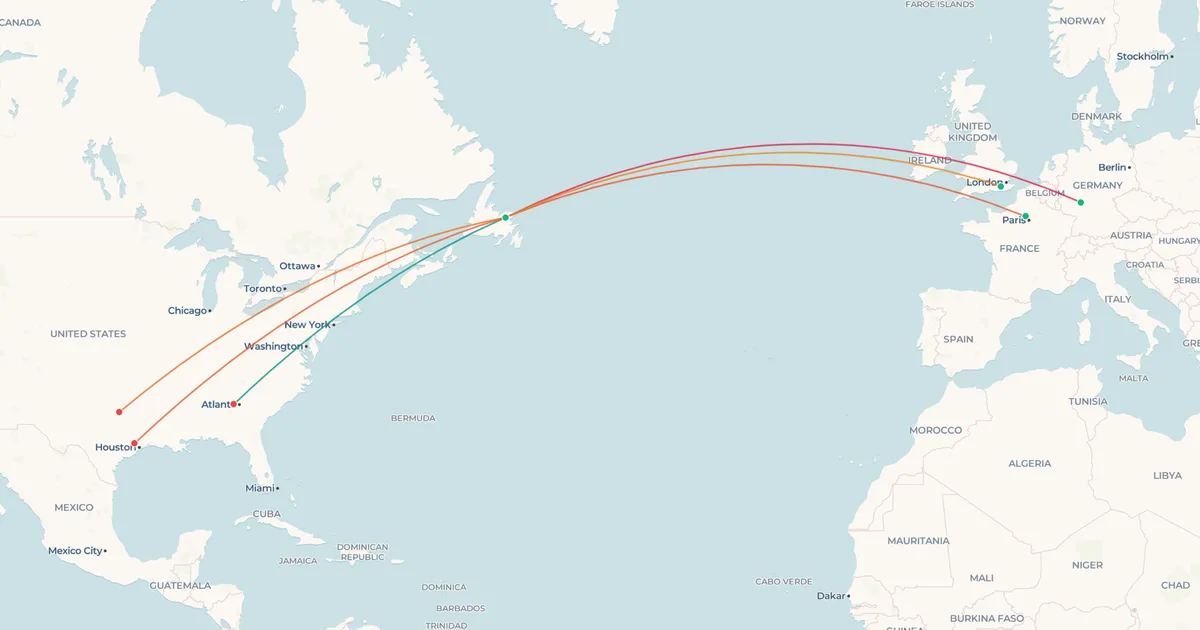
➕ Add these 6 flights to my map | 🗺️ Preview on the map | 📥 CSV
Every Nationwide Grounding, From 1960 to 2026
| When | Why, and for how long |
|---|---|
| 1960 10 September | Sky Shield I, an air defence exercise About 6 hours, overnight |
| 1961 14 October | Sky Shield II 12 hours |
| 1962 2 September | Sky Shield III About 5 and a half hours |
| 2001 11 September | The terrorist attacks Two days, to 13 September |
| 2023 11 January | The NOTAM system failed About 90 minutes, departures only |
| 2026 13 November | Air traffic control communications failed About 4 hours 20 minutes, departures only |
The two most recent are a different kind of stop from the others. A ground stop holds aircraft at their gates, but flights already in the air carry on to where they were going. On 11 September 2001 the FAA went much further and ordered every aircraft out of the sky.
Sky Shield: The Days Nobody Flew (1960 to 1962)
The first nationwide groundings were planned. During the Cold War, the North American Air Defense Command tested its defences with three exercises called Sky Shield, in which bombers played the part of a Soviet attack and fighters and radar stations tried to stop them. To keep the sky clear, every civil aircraft in the US and Canada was grounded.
The first, on 10 September 1960, ran for about six hours overnight, with Hawaii left out. The second, on 14 October 1961, was the longest: twelve hours on a Saturday, announced well in advance so that airlines could plan around it. The third, on 2 September 1962, lasted about five and a half hours. Passengers knew they were coming. Nobody has grounded the country on purpose since.
11 September 2001: Shutting the Sky
At 9:45 am Eastern time on 11 September 2001, Ben Sliney, on his first day as the FAA's National Operations Manager, ordered all US airspace closed. Under a plan called SCATANA, every aircraft in the air was told to land at the nearest suitable airport, and more than 4,000 were on the ground within hours. It was the first unplanned closure of American airspace. Civil flights were allowed to resume on 13 September, and Washington's Reagan National airport stayed closed for almost a month.
The hardest problem was out over the oceans. About 500 flights were on their way to the United States when the airspace closed. According to Transport Canada, 270 flights over the Atlantic were ordered to turn around and fly back to Europe. Those that were too far along had nowhere to go but Canada.
Operation Yellow Ribbon: The Flights That Landed in Canada
Canada called it Operation Yellow Ribbon. Transport Canada counted 224 diverted flights carrying more than 33,000 passengers, landed at 17 airports from Newfoundland to the Yukon, although other counts go as high as 255. Flights from Europe were kept away from the big cities of Toronto and Montreal and sent to the Atlantic coast. Halifax took the most aircraft, about 40, and Vancouver the most passengers, more than 8,500 on 34 flights from Asia.
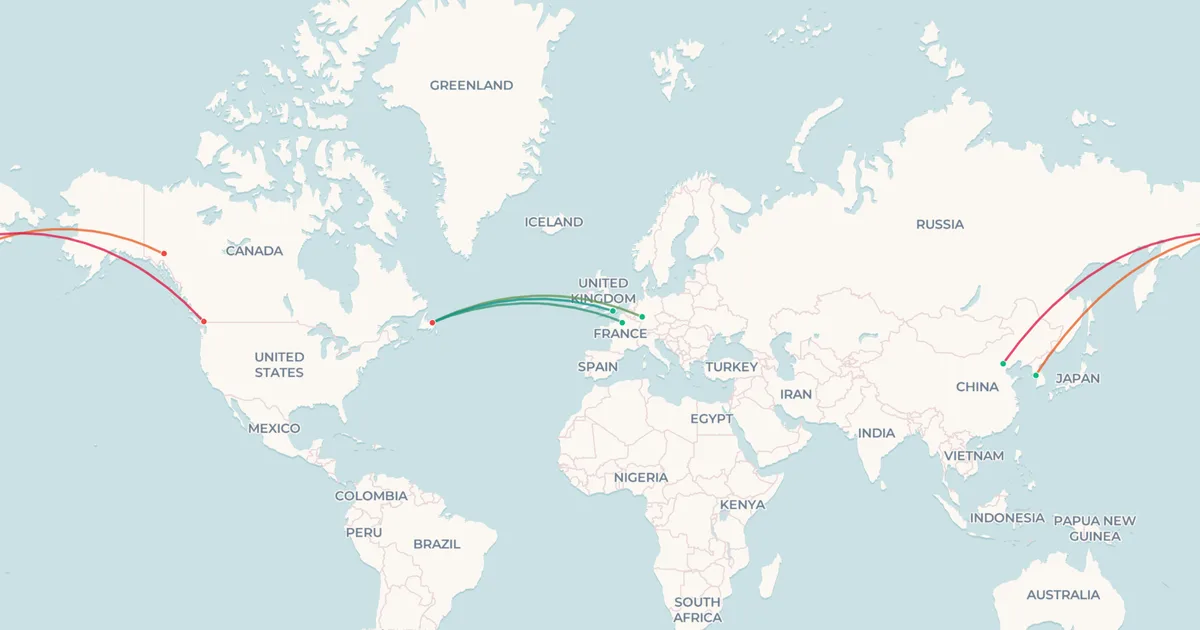
➕ Add these 5 flights to my map | 🗺️ Preview on the map | 📥 CSV
Gander, a town of about 10,000 people in Newfoundland, took 38 aircraft and more than 6,500 passengers and crew, and housed them in schools, churches and homes for several days. Among the aircraft were:
- Delta Air Lines Flight 15, Frankfurt to Atlanta.
- American Airlines Flight 49, Paris to Dallas, flown by Beverley Bass, the first woman to become a captain at American.
- Continental Airlines Flight 5, London Gatwick to Houston, whose passengers included two strangers who fell in love in Gander.
Their stories became the musical Come From Away. Lufthansa said thank you in its own way: in May 2002 it named an Airbus A340 Gander/Halifax, its first aircraft named after a place outside Germany.
Search flights Paris → DallasSearch flights CDG → DFWOn the Pacific side, two flights caused real alarm. Korean Air Flight 85, from Seoul to New York by way of Anchorage, sent a message containing the code for a hijacking. Fighter jets escorted it away from Anchorage to Whitehorse in the Yukon, where police met the aircraft. It was a false alarm, caused by a misunderstanding. An Air China Boeing 747 from Beijing to San Francisco was escorted into Vancouver by fighters for what turned out to be a communication problem.
January 2023: A Deleted File
For more than 21 years, nothing like it happened again. Then on the morning of 11 January 2023, the FAA stopped all departures because its NOTAM system had failed. NOTAMs are the notices that warn pilots about closed runways, broken lights and other hazards, and no flight can leave without checking them. The system had stopped processing updates the afternoon before.
The ground stop ran from about 7:30 am to just before 9 am Eastern time, but more than 11,000 flights were delayed or cancelled that day. The cause turned out to be mundane: contractors fixing a link between the main database and its backup had deleted files by mistake. The FAA found no sign of a cyberattack.
November 2026: When the Radios Went Quiet
The newest ground stop began at 20:54 UTC on Friday 13 November 2026, just before 4 pm Eastern time. The FAA cited a communications problem affecting its Air Route Traffic Control Centres, the big regional centres that handle aircraft at cruising height. Transportation Secretary Sean Duffy said the network's routers had become overloaded with data and started to give inconsistent information, and that some of the equipment was old analogue telecoms. Officials said there was no sign of a cyberattack.
The stop was lifted at 01:15 UTC, about 8:15 pm Eastern, more than four hours later. In that time, according to Cirium, at least 827 flights were diverted: 670 went back to the airport they had left, and 157 landed somewhere else. Some flights within Alaska and Hawaii kept going, and a few international departures were allowed out during the evening, but cancellations ran into the thousands and carried on into Saturday. The investigation is still going, and we will update this article when the FAA says what went wrong.
What a Ground Stop Actually Stops
A ground stop is a normal tool. Air traffic controllers use them every day at single airports, for storms, for runway problems, or when too many aircraft are heading to the same place. What made 2023 and 2026 rare is that they covered the whole country at once.
Even then, the sky does not empty. Aircraft that are already airborne are usually safest continuing to their destination, where controllers are expecting them. That is the big difference from 2001: 9/11 is still the only time the US ordered every aircraft in the air to land, and the only time flights from overseas were sent to another country instead.
FAQ
Has the FAA ever grounded all flights before?
Yes, five times before November 2026: the three Sky Shield air defence exercises in 1960, 1961 and 1962, the attacks of 11 September 2001, and the NOTAM failure of 11 January 2023.
How long did the November 2026 ground stop last?
About four hours and twenty minutes, from 20:54 UTC on 13 November to 01:15 UTC on 14 November, which is just before 4 pm to about 8:15 pm Eastern time.
What caused the November 2026 ground stop?
A communications failure affecting the FAA's regional air traffic control centres. The Transportation Secretary blamed overloaded network routers. Officials said there was no sign of a cyberattack, and the investigation is still going.
What happens to flights in the air during a ground stop?
They usually continue to their destination, because a ground stop only holds departures. In November 2026 some flights that had just taken off turned back or diverted, but the order did not tell every aircraft to land. Only on 11 September 2001 was every aircraft ordered out of the sky.
Where did flights go on 9/11?
Aircraft over the US landed at the nearest suitable airport. About 270 transatlantic flights turned back to Europe, and more than 220 flights heading for the US landed in Canada, 38 of them in Gander, Newfoundland.
Sources
- November 2026: Flightradar24 for the times, the FAA's statement, ABC News for Sean Duffy's explanation, and KPBS and CNBC for the Cirium figures.
- January 2023: the FAA's statement, NPR and FOX 5 New York.
- Sky Shield: Wikipedia and Air & Space magazine.
- 11 September 2001 and Operation Yellow Ribbon: Transport Canada and Wikipedia.
- The flights: NPR on Delta 15, TCU Magazine on American 49, KSL on Continental 5, CBC on Korean Air 85, and Aviation Week on the Gander/Halifax A340.
Six times in 66 years, the busiest sky in the world has gone quiet. Three were planned, and the other three were the kind of day nobody forgets.