Jet Lag & Timezone Calculator - Understand Your Flight's Time Zone Impact
SydneyLos Angeles
Your day, across the time zones
Press play or drag along the track: watch the night move and the clocks change
Shaded: night at that moment of the flight. Bands: the world's time zones, roughly every 15 degrees; real borders zigzag. Take-off and landing times use each airport's real time zone, for today's date.
That is one route. Your map holds all of them.
My Flight Routes turns every flight you have taken into a single interactive map, with your own stats, milestones and a replay of everywhere you have been. Start it with this one.
Free, and you can start without an account.
How many time zones will you cross? Flying across multiple time zones causes jet lag, a combination of physical fatigue and circadian rhythm disruption. My Flight Routes calculates your jet lag risk on a 1-10 scale by analyzing timezone difference, travel direction and flight duration. Plan better travel recovery with data-driven insights.
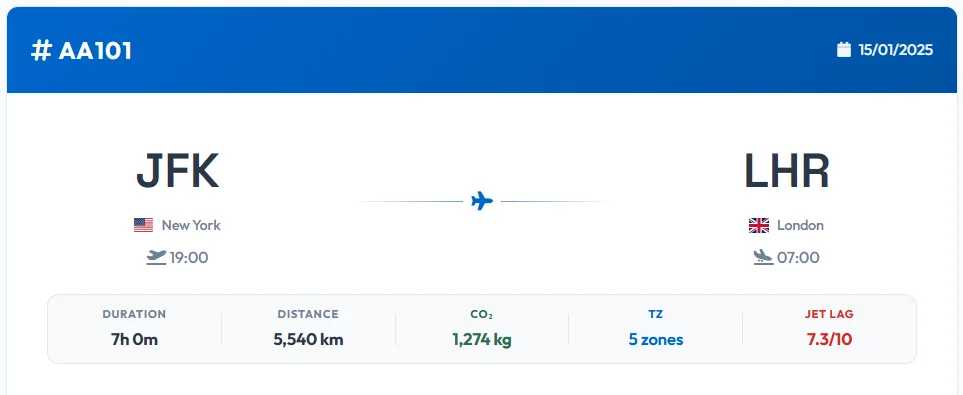
Preview of jet lag risk scoring and timezone crossing information displayed on flight details.
What Are These Metrics?
Jet Lag Risk is a 1-10 score that combines three factors: the number of time zones crossed, whether you're flying east (harder) or west (easier), and your flight duration. The Timezones metric shows the total number of time zones between your departure and arrival airports. Together, these help you understand and prepare for travel disruption.
How We Calculate Jet Lag Risk
The jet lag risk score uses a science-based algorithm that factors in:
- Timezone Difference: Base score from the number of time zones between airports (each 15° of longitude ≈ 1 hour)
- Travel Direction: Eastbound flights multiply risk by 1.5x (you must advance your sleep cycle, fighting your body's natural rhythm)
- Flight Duration: Flights over 12 hours add extra risk (0.5-1.5 points) due to extended exposure and fatigue
- Result: 1-10 scale from Minimal (≤1) to Extreme (>8) to help you plan recovery time
Why Eastbound Is Harder
When flying east, you compress your day and travel against Earth's rotation. Your body needs to *advance* its sleep cycle (fall asleep earlier), which is harder than the westbound pattern (delaying sleep). Factors affecting difficulty:
- Circadian Rhythm: Your natural sleep-wake cycle is ~24.5 hours; east travel forces it shorter
- Recovery Time: Eastbound typically requires 1.5x longer recovery (roughly 1 day per time zone vs. 0.5-1 day westbound)
- Sleep Timing: Arriving at a destination when your body thinks it's the middle of the night is disruptive
- Adaptation Speed: Westbound travelers can gradually delay sleep; eastbound requires abrupt schedule shifts
Why Track Jet Lag Risk?
Understanding your jet lag impact helps you:
- Plan Recovery: Know how much rest you need after arrival before important meetings or activities
- Optimize Travel: Compare routes and arrival times to minimize circadian disruption
- Manage Expectations: Long haul + eastbound? Expect significant adjustment; prepare accordingly
- Strategic Scheduling: If possible, add recovery days to your itinerary for challenging routes
- Biohack Informed: Understand your body's adjustment challenges before applying jet lag remedies
Start Tracking Your Flight Impact
Add your flights to My Flight Routes and automatically see jet lag risk and timezone crossing data. Works in offline mode, no account required to get started. Track flights, see detailed metrics on flight detail pages, and analyze your complete travel history. For frequent flyers and anyone planning long-distance trips who want to understand travel fatigue patterns. Use our interactive airport selector to quickly add flights and start analyzing.
FAQ
Why is eastbound travel harder than westbound?
Your body's natural circadian rhythm is slightly longer than 24 hours (~24.5 hours). Traveling west lets you delay sleep (easier), but traveling east requires advancing sleep earlier (harder). Biologically, our bodies adapt faster to delays than advances. That's why jet lag flying east typically takes 1.5x longer to recover from.
What does the 1-10 jet lag score mean?
Scores: 1-2 = Minimal to Very Low (barely noticeable), 3-4 = Low (slight fatigue expected), 5 = Moderate (noticeable adjustment), 6-7 = Moderate-High to High (significant fatigue), 8-9 = Very High to Extreme (very challenging recovery). Score is based on timezone difference, eastbound multiplier, and flight duration.
How many days does jet lag last?
General rule: 1 day of recovery per time zone westbound, 1.5 days per zone eastbound. A 6-hour eastbound flight (9/10 risk) might need 4-6 days to fully adjust. Personal factors like age, sleep schedule flexibility, and adaptation practice significantly affect actual recovery time. Younger people and early risers typically adapt faster.
What can I do to reduce jet lag?
Pre-trip: Gradually shift sleep 2-3 days before travel in your desired direction. During flight: Stay hydrated, avoid alcohol/caffeine, and try to sleep matching destination time. Post-arrival: Light exposure is crucial (morning light for eastbound, evening light for westbound). Short-term melatonin, strategic napping (20-90 min), and consistent meal timing also help adaptation.
Try it instantly - no account required