Can You See the Northern Lights from a Plane?
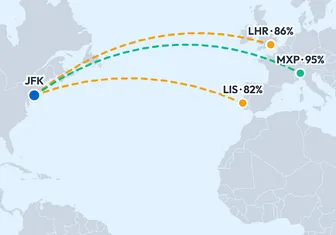
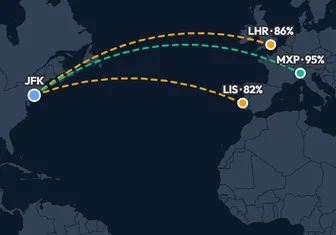
Yes, and often better than from the ground. At 11,000 metres you are above the clouds and far from city lights, and on the right route the aurora can be in view for hours. The best flight is an overnight eastbound crossing of the North Atlantic in winter, sitting on the left side. On an ordinary winter night, Air Canada's evening flight from Toronto to London has the northern lights in view for about 5 hours 40 minutes.
Those numbers come from our Northern Lights Flight Planner, which walks a flight's path minute by minute, checks whether the sky is dark and whether the auroral oval is in view, and says which side it is on. We ran it on twelve real routes at their scheduled departure times to see which ones deliver, and the answers are more interesting than "sit on the left".
Which Side of the Plane to Sit On
The northern lights sit in a ring around the magnetic pole, so from most flights they are to the north. That gives a simple rule:
- Flying east (North America to Europe), north is on your left. Seat A is on the left on almost every airline.
- Flying west (Europe to North America), north is on your right: seat F on a narrow-body, usually K or L on a wide-body.
- Flying north, straight towards the ring, the aurora is ahead of you and either side works.
- For the southern lights everything flips: the ring is to the south, so flying east from Australia to South America it is on your right.
The rule has one important exception, which we come to below: flights that pass inside the ring, where the aurora is behind you, towards the south.
The Best Flights to See the Northern Lights
Here are the twelve routes, ranked by how long the aurora is in view on a typical winter night (Kp 3, see below), with what a storm night adds. Northern routes are measured on 15 December 2026, southern ones on 20 June, both near the longest night of the year. Click a route to open it in the planner and change the date.
| Route | Departs (local) | Aurora in view, typical night | Side | Storm night (Kp 5) |
|---|---|---|---|---|
| Toronto to London | 20:30 | 5 h 39 min | Left | 6 h 18 min |
| Melbourne to Santiago | 12:00, June | 5 h 18 min | Right | 6 h 09 min |
| New York to Hong Kong | 01:55 | 5 h 16 min | Both, mostly right | 5 h 16 min |
| Boston to Reykjavik | 20:50 | 4 h 39 min | Mostly left | Whole flight |
| Boston to Dublin | 21:15 | 4 h 33 min | Left | 5 h 35 min |
| Sydney to Santiago | 12:20, June | 4 h 24 min | Right | 5 h 49 min |
| New York to London | 21:00 | 4 h 21 min | Left | 5 h 29 min |
| Anchorage to Seattle | 19:55 | 2 h 45 min | Left | Whole flight |
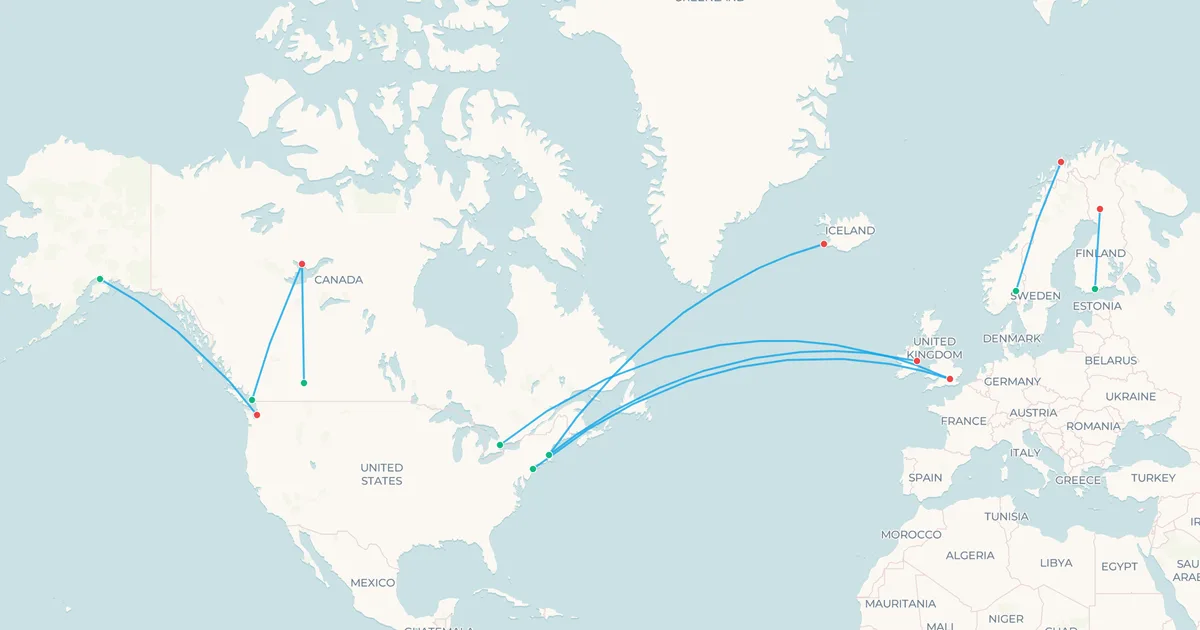
| Vancouver to Yellowknife | 20:20 | 2 h 19 min | Ahead, either side | Whole flight |
| Calgary to Yellowknife | 18:50 | Whole flight | Right | Whole flight |
| Oslo to Tromsø | Evening | Whole flight | Overhead | Whole flight |
| Helsinki to Rovaniemi | Evening | Whole flight | Left | Whole flight |
➕ Add these 9 routes to my map | 🗺️ Preview on the map | 📥 CSV
Those are the nine northern flights on one map. The aurora sits in a ring over northern Canada, southern Greenland, Iceland and the north of Norway and Finland, which is why every one of them heads that way. Click a route in the table to see its stretch under the aurora in the planner.
Why the North Atlantic Overnight Is the Classic
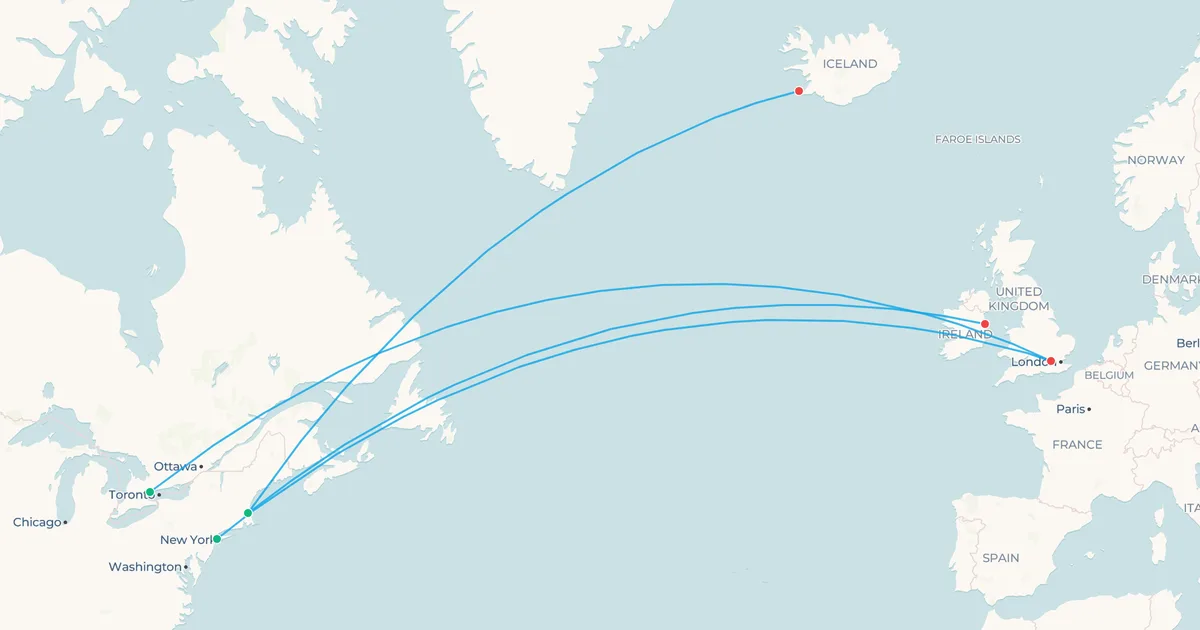
The evening departures from Toronto, Boston and New York are almost made for this. They leave after dark, fly north-east along a great circle that bends up towards Greenland and Iceland, and spend most of the night just south of the auroral ring, close enough to see it and far enough to keep it on one side of the plane.
➕ Add these 4 routes to my map | 🗺️ Preview on the map | 📥 CSV
Toronto beats New York by more than an hour, and not because of the distance. Toronto lies further north and further west, closer to the magnetic pole, which sits over the Canadian Arctic rather than the geographic pole. So the Toronto flight starts closer to the ring and stays closer to it. Boston to Reykjavik goes furthest north of all and flies right into the ring near Iceland, which is why its side is "mostly" left: for the last stretch the aurora is overhead.
New York to London is the weakest of the four on a quiet night, with the aurora low on the horizon rather than high in the sky, but it is also the route with the most flights. On a storm night it gains over an hour.
Search flights Toronto → LondonSearch flights YYZ → LHRWhat Time of Night, and Why Direction Matters
The aurora is there day and night, but you can only see it in a properly dark sky, with the sun at least 12 degrees below the horizon. That makes the departure time and the direction of travel matter as much as the route.
Flying east, you fly into the night, and the dark comes sooner. Flying west, you chase the sun. The most striking case is Icelandair's afternoon flight from Reykjavik to Seattle. It leaves at 16:50 in mid-December, when Iceland is already dark, and flies almost 8 hours across Greenland and northern Canada, right under the auroral ring. Our planner gives it zero minutes of dark sky: it keeps pace with the sunset all the way to Seattle, and the sky stays in twilight. Try it in the planner.
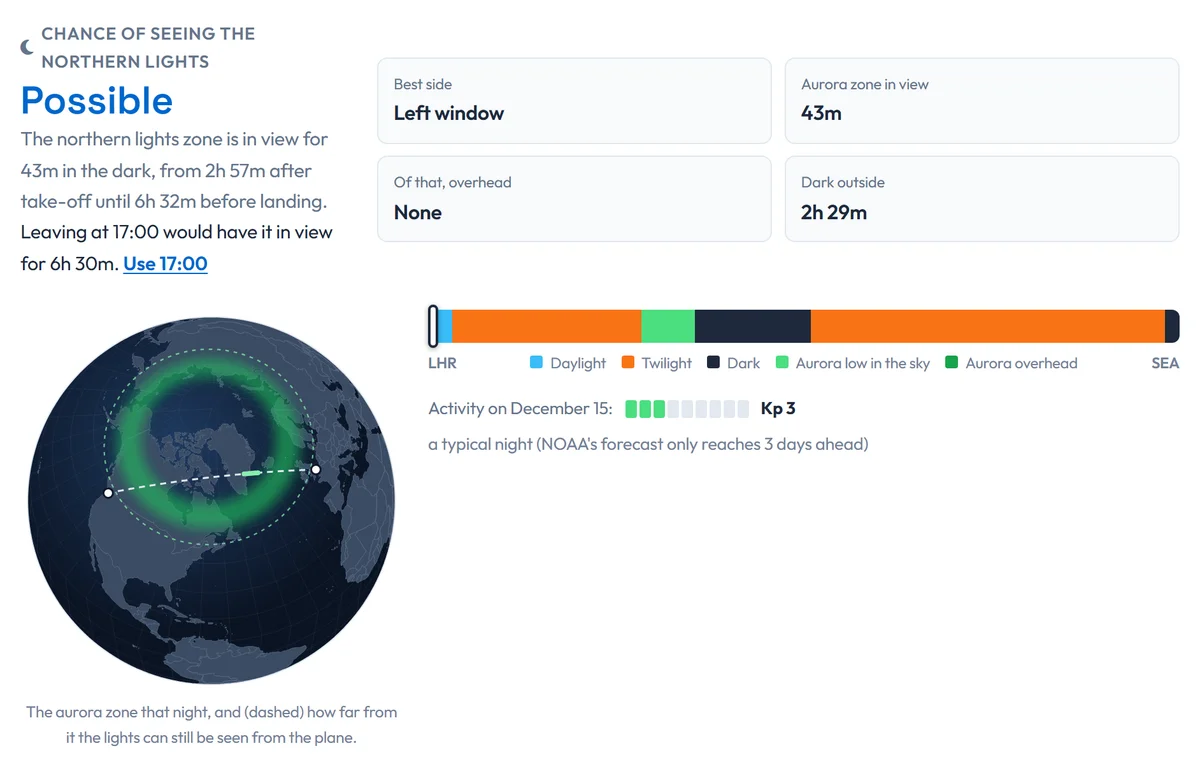
The same thing happens from London. British Airways' afternoon flight to Seattle gets 43 minutes of aurora, with most of the flight in twilight:
🌌 Open this flight in the planner
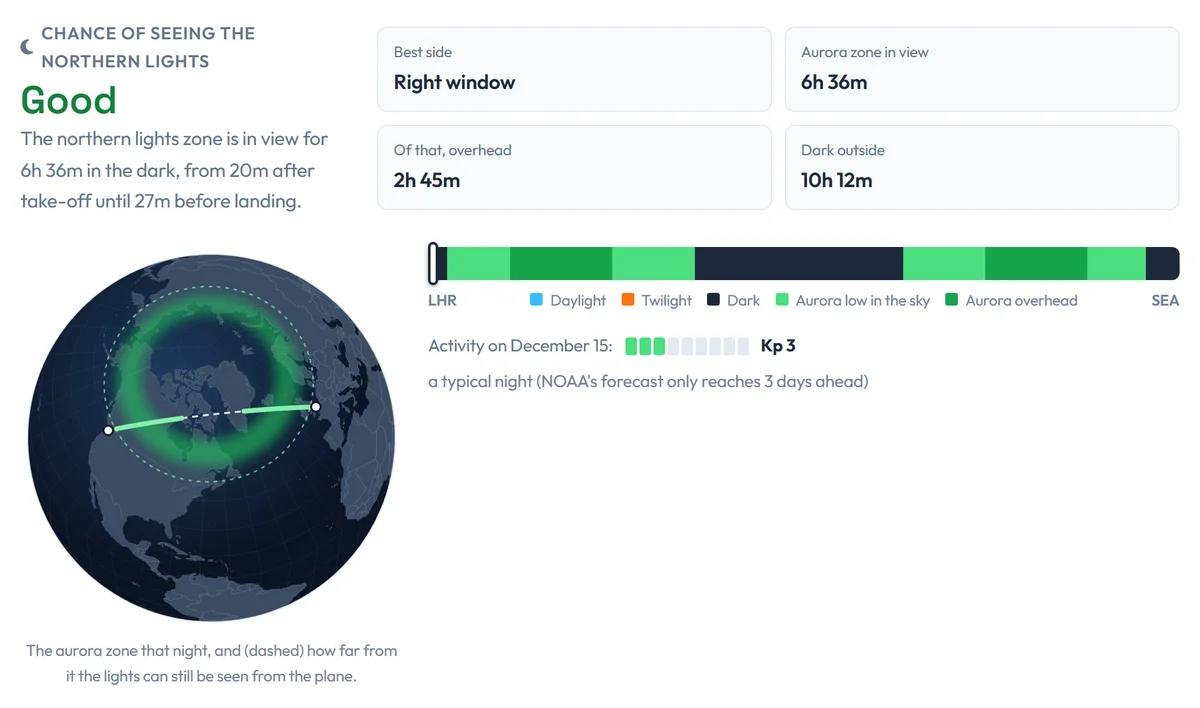
Leave the same route at 18:00 instead and it is dark the whole way, with the aurora in view for over 6.5 hours:
🌌 Open this flight in the planner
So for westbound flights, the later the better. For eastbound ones, the evening departures already fly through the darkest part of the night.
Inside the Ring: When the Side Switches
Look at the London to Seattle globe again. The route does not just pass the ring, it crosses it, flies across the middle, and crosses it again. Inside the ring, over the polar cap, the aurora is no longer to the north. It is behind you, towards the south, so the "right side going west" rule flips while you are in there.
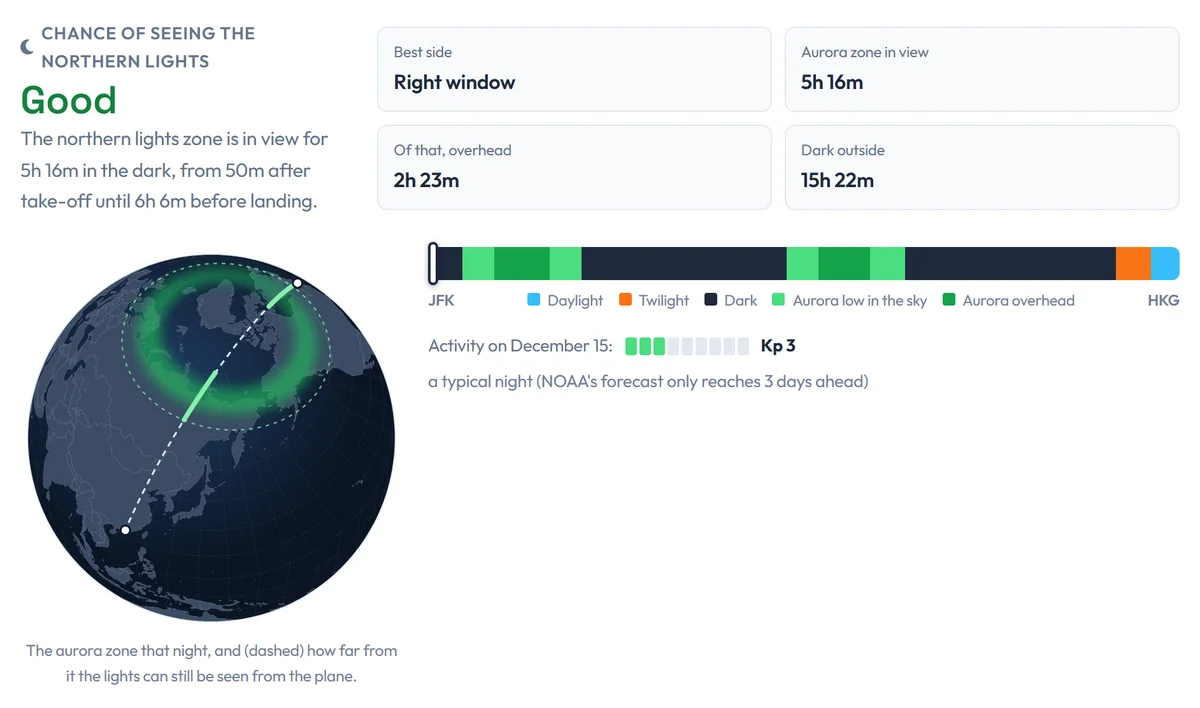
Polar routes between North America and Asia do the same. Cathay Pacific's overnight flight from New York to Hong Kong crosses the ring over northern Canada, flies over the Arctic Ocean, and crosses it again over Siberia, with the aurora in view for about 5 hours 16 minutes. The side changes twice, so neither window is ideal for the whole time. The best bet is to check the route in the planner, which shows the side minute by minute. We cover how these routes go over the top of the world in our guide to transpolar flight routes.
Short Flights Into the Aurora
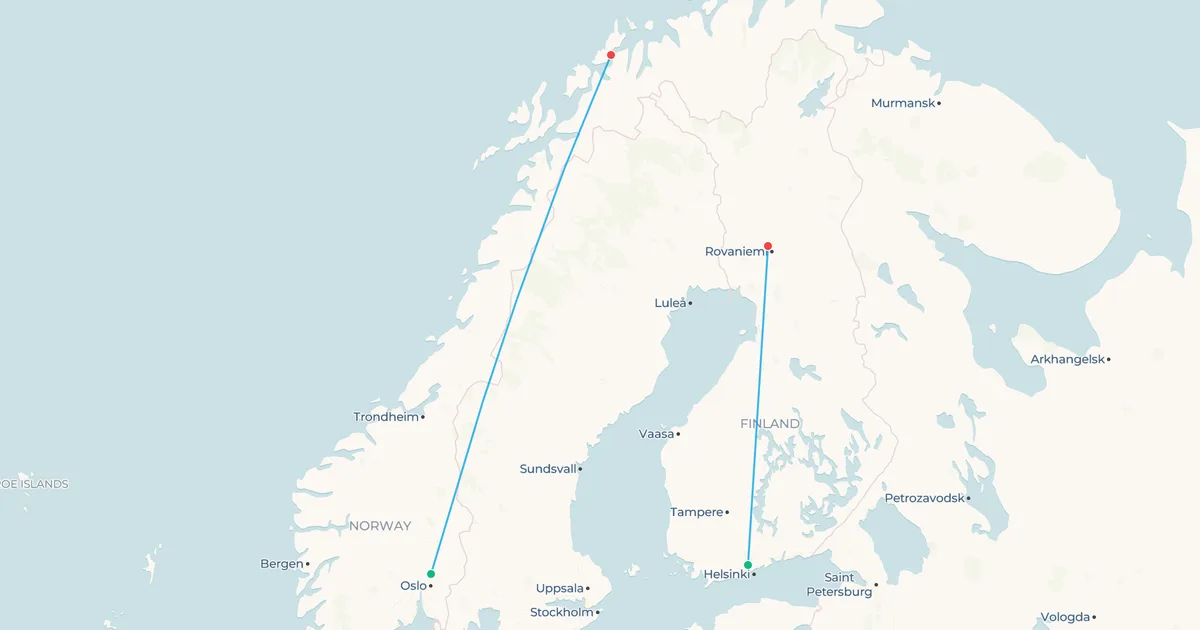
Long flights win on hours, but short flights to aurora country win on share. An evening flight from Oslo to Tromsø, Helsinki to Rovaniemi or Calgary to Yellowknife has the aurora in view for the whole flight, much of it directly overhead, because the destination sits under the ring.
➕ Add these 2 routes to my map | 🗺️ Preview on the map | 📥 CSV
These are also the flights people take to go aurora hunting, so the show can start before you land. Oslo to Tromsø flies north up the length of Norway, and for almost the whole flight the aurora is overhead rather than to one side.
➕ Add these 3 routes to my map | 🗺️ Preview on the map | 📥 CSV
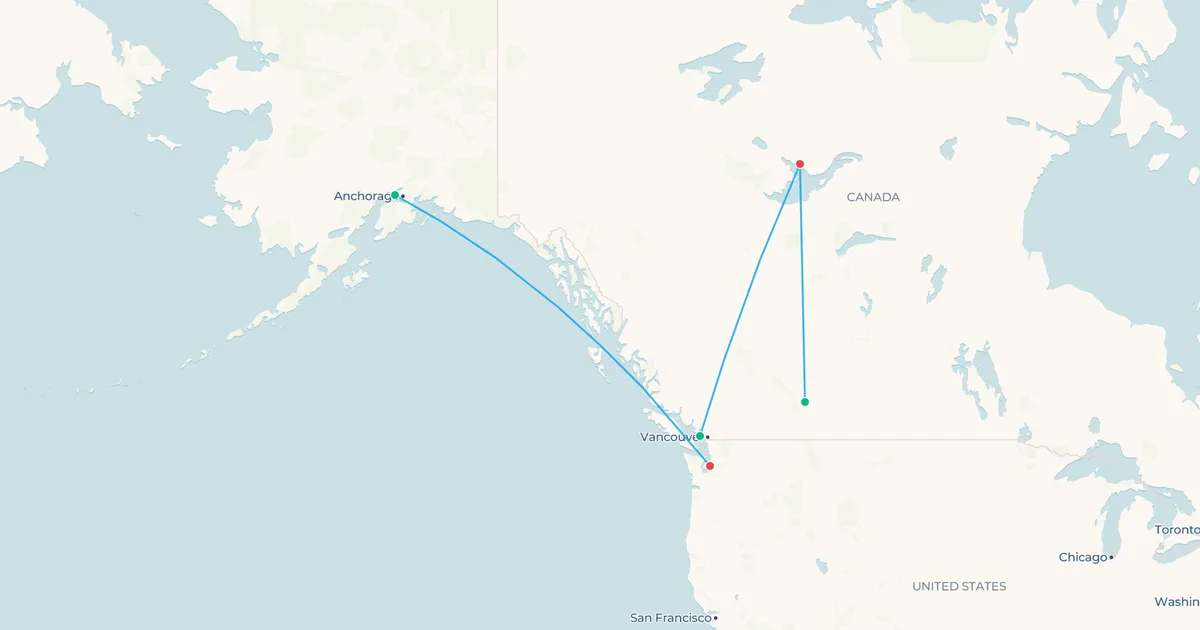
Yellowknife, in Canada's Northwest Territories, is one of the most reliable aurora destinations on Earth, and the flight there is a preview. From Vancouver you fly almost straight at the ring, so the aurora is ahead rather than to one side. From Calgary it is on the right. Going the other way, the evening flight from Anchorage to Seattle has it on the left for about 2 hours 45 minutes.
Search flights Oslo → TromsøSearch flights OSL → TOSThe Southern Lights from a Plane
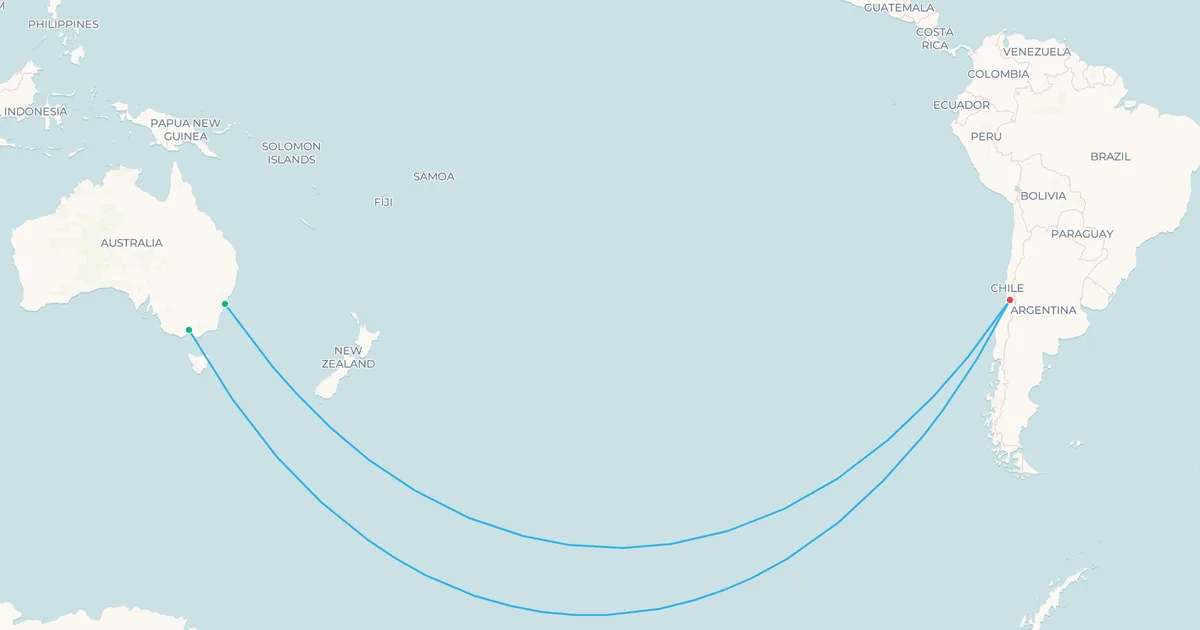
The southern hemisphere has its own ring, around the south magnetic pole off Antarctica, and a few flights get close enough to see the aurora australis. The best are the flights from Australia to Santiago in the southern winter, which take a great circle that dips far south over the Pacific.
➕ Add these 2 routes to my map | 🗺️ Preview on the map | 📥 CSV
Melbourne to Santiago comes closest, with the aurora in view for about 5 hours 18 minutes on a typical June night, much of it overhead. Sydney to Santiago passes further north and sees it lower on the horizon. Both fly east, so the aurora is on the right. Both also leave around midday and reach the dark over the ocean, which is why the window opens a few hours into the flight.
On a Storm Night
Everything above is for a typical night. Aurora activity is measured on the Kp index, from 0 to 9, and our "typical night" is Kp 3. At Kp 5, a minor geomagnetic storm, the ring grows towards the equator: New York to London gains over an hour, and Sydney to Santiago almost an hour and a half.
At Kp 9 the aurora reaches places that almost never see it. That happened on 10 and 11 May 2024, one of the strongest storms in decades, when the aurora was photographed across Spain. A night flight from Madrid to Buenos Aires would have needed exactly that: on any ordinary night it never comes close.
The Sun reached the peak of its 11-year cycle in late 2024. Activity is easing, but big storms keep coming for a while after the peak, so this winter is still a good one to try. The planner reads NOAA's live forecast, so for flights in the next few days it uses the real expected activity instead of a typical night.
How to Actually See It from Your Seat
- Book the window on the right side using the rule above, and check your exact flight in the planner if it crosses the ring.
- Kill the reflections. Turn off your reading light and screen, and drape a blanket or jacket over your head and the window.
- Give your eyes 10 to 15 minutes to adjust. A faint aurora looks grey to the eye; a phone in night mode often shows the green before you can.
- Ask the crew. Pilots see it first from the flight deck, and on some routes they announce it.
- Go between October and March. In summer the northern routes stay in daylight or twilight and you will see nothing, however strong the aurora is.
For more flights worth a window seat in daylight, see our guide to the most scenic flight routes.
Frequently Asked Questions
Which side of the plane is best for the northern lights?
The left side when flying east, from North America to Europe, and the right side when flying west. Flights that pass inside the auroral ring are the exception: there the aurora is towards the south, so the side switches for that stretch.
Can you see the northern lights from a plane?
Yes, on night flights at high latitudes in the winter months. Above the clouds and away from city lights, the view is often better than from the ground. On a typical night, an evening flight from Toronto to London has the aurora in view for about 5 hours 40 minutes.
What is the best flight to see the northern lights?
Of the routes we measured, Toronto to London has the longest view on a typical night. Short evening flights to Tromsø, Rovaniemi or Yellowknife have it in view for the whole flight.
What time of year can you see the northern lights from a plane?
From roughly October to March. In summer the high-latitude routes stay in daylight or twilight through the night.
Can you see the southern lights from a plane?
Yes. Flights from Melbourne and Sydney to Santiago pass close enough to the southern auroral oval in the southern winter, June and July. Sit on the right side.
Why didn't I see the northern lights on my flight?
Usually because the sky was not dark enough, especially on westbound flights that chase the sunset, because activity was low that night, or because of reflections from the cabin lights.
Sources
Minutes in view, sides and windows are our own calculations with the Northern Lights Flight Planner, on the great circle between the airports at each flight's scheduled local departure time. Real flights follow tracks that change from night to night, so treat them as what a typical night offers, not a promise.
- The model: the auroral oval around the geomagnetic pole, at 80.8°N 72.8°W in 2025, from NOAA's National Centers for Environmental Information.
- Activity: the Kp index and forecast from NOAA's Space Weather Prediction Center.
- The solar cycle: NASA and NOAA on the Sun reaching the maximum of its cycle in October 2024.
- The May 2024 storm: Wikipedia.
- Schedules: airline timetables and flight trackers, October 2026.
The aurora is the same for everyone on board. What changes is the seat, the hour and the direction, and those you can choose.